

At low solute concentration the changes in boiling point, freezing point, vapor pressure and the osmotic pressure of a solution are all proportional to the amount of a non-volatile solute dissolved in the solvent. These phenomena are known as colligative properties of solutions. The colligative properties of a solution depend only upon the number of solute particles present in a given amount of solvent and on whether or not the solute is an electrolyte or a nonelectrolyte.
Solute concentrations are usually measured in molality (moles of solute/kg of solvent) as the relationships that describe freezing point depression and boiling point elevation are much simplified and become
 and

where
 is the change in the temperature between the
solution and the pure solvent,
 the boiling point elevation
constant for the solvent and
 the freezing point depression constant for the solvent. Each solvent has different
and
values.
In this experiment, you will determine the freezing point of tert-butyl alcohol (tert-butanol). Next, using naphthalene you will determine the molal freezing point constant of tert-butanol. Finally, you will determine the molar mass of an unknown substance and identify it among several substances. The freezing point will be obtained by observing the rate at which liquid tert-butanol and its solutions cool in air.
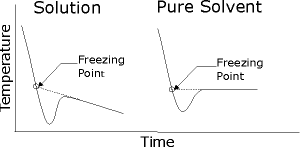
Temperature - time graphs, called cooling curves, are presented below to demonstrate the supercooling of a liquid. A dip in the cooling curves indicates that the liquid has supercooled. If supercooling is present, it is necessary to extrapolate the linear portion of the solid - liquid curve back to the liquid curve to obtain the freezing point.
Avoid breathing vapors from or skin contact with the tert-butanol, naphthalene and the unknown. Wear your safety glasses.
The following video provides information on lab safety and security:
Using the Handbook of Chemistry and Physics, prepare a table of physical properties, as found in the Chemistry Guide, that includes the structure, molar mass, density, melting point, boiling point and solubility of tert-butanol, naphthalene (C10H8), benzophenone (C13H10O), para-dichlorobenzene (C6H4Cl2) and benzil (C14H10O2). Provide the reference.
Find the theoretical molal freezing point depression constant for tert-butanol from a credible source (provide the reference).
Prepare a table of observations and a data table for Part A of the experiment.
Part A - Freezing point of pure tert-butanol
Obtain a test tube, into which 25.00 mL of tert-butanol has been added by the lab technician. Fix it to a support with a clamp. Calculate the mass of tert-butanol.
Place the stirrer and a thermometer (accuracy 0.1°C) into the test tube containing tert-butanol. Handle the thermometer with care. It is fragile!! Clamp the thermometer with the thermometer clamp.
From this point on, do not remove the thermometer and stirrer from the test tube until you have completed the entire experiment. The quantity of tert-butanol that was placed in the test tube will be the quantity for this entire experiment. If you remove the thermometer OR the stirrer you will lose some tert-butanol, and, thus, your experiment will not work as it should.
Make sure that the tert-butanol is a liquid. The freezing point of tert-butanol is approximately at the same temperature as the laboratory. If the tert-butanol has solidified, place a beaker (400 mL) containing lukewarm (approximately 25°C) water around the test tube to melt the crystals. Gently and with a constant rhythm, mix the tert-butanol with the stirrer. Make sure that the tert-butanol does not spill out of the test tube.
Add cool (approx. 20-22°C) tap water to another 400-mL beaker. Intermittently, plunge the test tube into the beaker of cool water for a few seconds so that the tert-butanol in the test tube cools at approximately 1°C/min. The level of cool water in the beaker should be about 1 cm below the level of tert-butanol in the test tube. Continue stirring gently and with a constant rhythm throughout the entire cooling process!!! Note the temperature of the first appearance of tert-butanol crystals, and the physical properties of the crystals (color, crystal shape, crystal brilliance).
Repeat the above process five (5) or six (6) times in order to obtain five (5) freezing points within 0.2°C. Verify the values with your professor before continuing.
Part B - Determination of the molal freezing point constant of tert-butanol
Transfer approximately 0.8 g of naphthalene into the test tube containing 25.00 mL of tert-butanol. To do this you must weigh by difference. If you do not remember how to do this, look it up before coming to the laboratory. Ensure that all the naphthalene is transferred into the test tube and NOT on the lab bench! In other words, be careful that you do not spill the naphthalene while transferring it. Gently and with constant stirring, heat the test tube in a beaker containing warm water until all the naphthalene dissolves. The temperature at which a solution is obtained in not important, it is only important that you obtain a solution. Maintaining the gentle and constant stirring, cool the solution as you did for the pure tert-butanol (1°C/min) in Part A. Once again, note the temperature of the first appearance of tert-butanol crystals, and the physical properties of the crystals (color, crystal shape, crystal brilliance). Repeat the above process five (5) or six (6) times in order to obtain five (5) freezing points within 0.2°C. Check the values with your professor. Once completed, melt the contents of the test tube and place them in the waste beaker.
Part C - Determination of the molar mass of the unknown
Transfer approximately 0.7 g of the unknown (note unknown number and take its observations) into the test tube containing 25.00 mL of tert-butanol. To do this you must weigh by difference. If you do not remember how to do this, look it up before coming to the laboratory. Ensure that all the unknown transferred into the test tube and NOT on the lab bench! In other words, be careful that you do not spill the unknown while transferring it. Gently and with constant stirring, heat the test tube in a beaker containing warm water until all the unknown dissolves. The temperature at which a solution is obtained in not important, it is only important that you obtain a solution. Maintaining the gentle and constant stirring, cool the solution as you did for the pure tert-butanol (1°C/min) in Part A. Once again, note the temperature of the first appearance of tert-butanol crystals, and the physical properties of the crystals (color, crystal shape, crystal brilliance). Repeat the above process five (5) or six (6) times in order to obtain five (5) freezing points within 0.2°C. Check the values with your professor. Once completed, melt the contents of the test tube and place them in the waste beaker.