|
| see reference1 |
With the drastic increases in the cost for fossil fuels and environmental concerns due to global warming that is associated with combustion processes, many people are seeking alternative energy sources. Biodiesel, also referred to as vegetable oil methyl ester (VOME), is a common alternative to fossil fuels, since it is generally an inexpensive product to create. In addition, when compared to conventional diesel, the use of biodiesel reduces the net amount of CO2 emissions, which are widely attributed to the problem of global warming since CO2 is a greenhouse gas.2 Since 2007, Montréal has been using city buses that run on a biodiesel/diesel blend,3 and in January of 2018 the city has committed to implementing 300 new hybrid buses by 2020.4
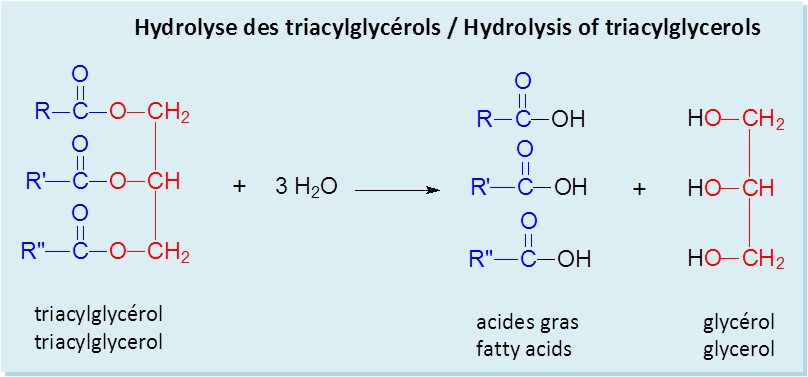
One main reason why biodiesel is generally inexpensive to make is because the starting materials are easy to obtain. A common and cheap way to make biodiesel is to use waste oil,5 for example from restaurant deep fryers. These waste vegetable oils (WVO) contain two types of useful components to making biodiesel: free fatty acids and triglycerides. Free fatty acids are created during cooking due to the hydrolysis of the triglycerides (see reaction below).6
Vegetable oils are obviously from biological sources and as such can be classified in biological terms. They are part of the group of biomolecules known as lipids.7 Lipids are a heterogeneous class of naturally occurring organic substances grouped together not by the presence of a distinguishing functional group or structural feature, but rather on the basis of common solubility properties. Lipids are all insoluble in water and highly soluble in one or more organic solvents, including ether, chloroform, benzene, and acetone. In fact, these four solvents are often referred to as "lipid-solvents" or "fat-solvents". Proteins, carbohydrates, and nucleic acids are largely insoluble in these solvents.8
Lipids are widely distributed in both animal and plant systems and perform a wide variety of functions. These include energy storage, structural components (e.g. cell membranes), vitamins, metabolism regulators (e.g. steroid hormones) and emulsifying agents.9 Lipids are further divided into five major types: fats, oils, phospholipids, fat-soluble vitamins, and steroids.
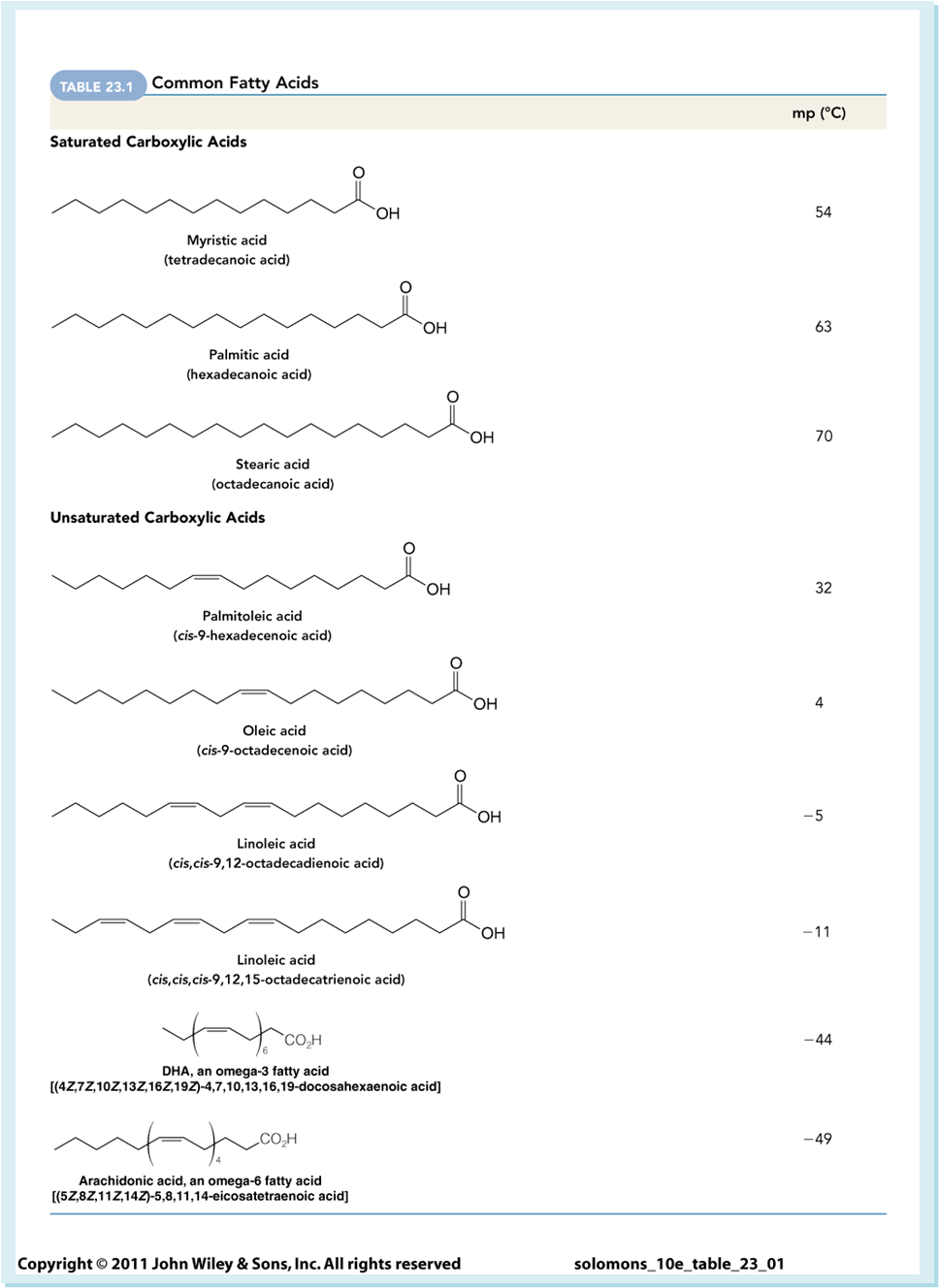
The most abundant lipids are triesters of glycerol with long-chain "fatty" acids. The triesters or triacylglycerols (triglycerides) from animal sources are usually low-melting solids, and are called fats, while those from plants are viscous oils that solidify below 0°C.7 The general structures are the same, and the difference in properties arises from the fact that the vegetable oils contain a larger proportion of unsaturated acid groups, with one, two or three double bonds in the chain. Triglycerides such as beef tallow and other depot fats of animals contain mostly acid chains with one or no double bonds. Fatty acids invariably have chains with an even number of carbon atoms, most commonly 16 or 18. A few of the more important fatty acids are listed in Table 23.1 (below).7 These and several others can occur in any combination in a given triglyceride.
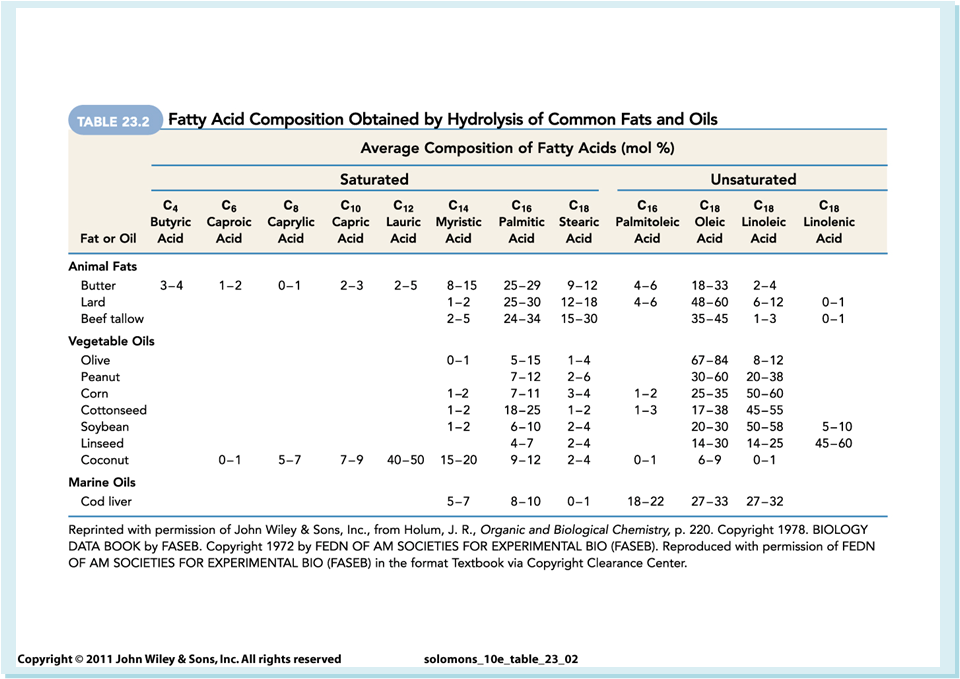
Butterfat is
atypical, since the mixture of acids in the triester contains a significant
number of 8-, 10- and 12-carbon chains. The composition of a few fats and oils
is given in the Table 23.2 (below).7 These values vary over a fairly wide range,
depending on the source of the oil, and there is no one "correct"
figure. As a typical and representative vegetable oil, consider canola, i.e. corn oil.
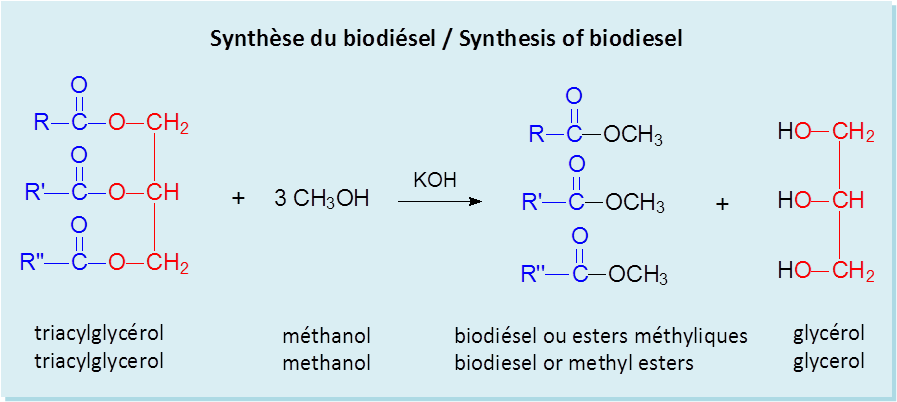
The primary objective in making biodiesel is to convert the triglyceride into methyl esters. In this experiment, you will be performing a base-catalysed transesterification that converts the triglyceride content in the oil into the methyl esters (see reaction below).6 Furthermore, you will analyze the product produced. Due to the differences in polarity between the methyl esters and glycerol, these two compounds are easily separable. Prior to starting the transesterification reaction, the waste vegetable oil needs to be free of solid cooking residues and dried. This preparation of biodiesel is very similar to one of the methods used commercially.6
Soap is a common by-product in this reaction, which reduces the overall
product yield.6 It is commonly formed when excess base is still present during
the water washings of the newly formed biodiesel methyl esters. To prevent
this, a small amount of concentrated ethanoic acid is added to neutralize the excess base present in the
methyl esters. The other product in the reaction scheme shown above is glycerol,
which is, in itself, a commercially useful material and hence it is not just
"waste".6