| Organic Chemistry by Solomons, Fryhle and Synder 11th and 12th editions |
| Chapter 15 Reactions of aromatic compounds |
Active-learning Questions (completed individually)-
Provide
the general electrophilic aromatic substitution (EAS) reaction, as well
as all the specific EAS reactions of benzene. Provide the
general mechanism for this reaction including all the resonance structures of
the arenium ion. Name the steps of the mechanism.
- Provide the major product formed when
benzene reacts with 1-chloro-2-methylpropane in the presence of aluminum
trichloride. Provide the mechanism for this reaction. Solved problem 15.2 is important.
- Synthesize pentylbenzene from benzene
and pentanoyl chloride. Provide the names of the electrophilic
aromatic substitution reactions used. Problem 15.5 (A and B) is important.
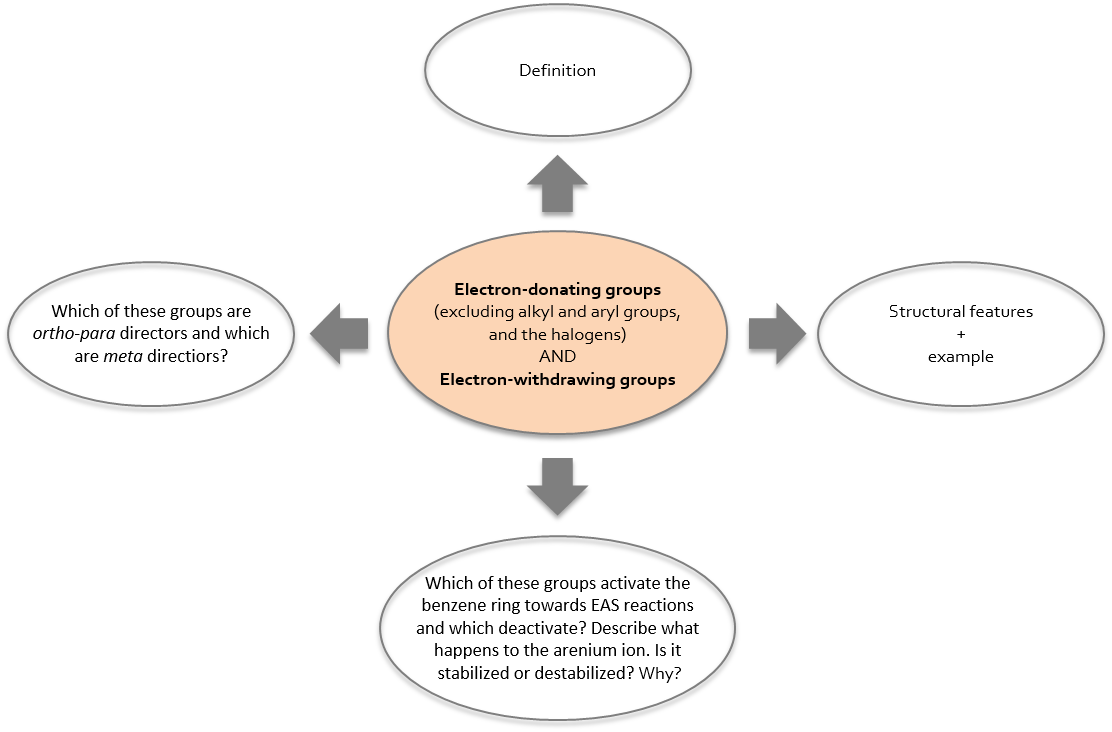
- Substituents attached to a benzene ring may be
classified as either electron-donating or as electron-withdrawing groups. Prepare a circle diagram (example below) for
each group.
Portfolio Questions (completed individually)
- Following the examples given in the solved problem 15.4, as well as the practice problems 15.7, 15.11, 15.12, 15.20
and 15.21, predict the products formed after each step of
the following reaction sequences.
If the final product would be a mixture of ortho and para isomers,
you should state so. In addition, if
possible, state which of these isomers is the major one.
| a | Biphenyl
(phenylbenzene) is chlorinated | | b | Benzophenone
reacts with 1-chloropropane in the presence of AlCl3 (cat.) | | c | p-Chloroacetophenone is nitrated | | d | 3-Chlorobenzoic
acid is brominated | | e | 4-Acetoxybiphenyl
is sulfonated | | f | N-Phenylbenzamide (benzanilide)
is brominated | | g | 4-Methoxybenzaldehyde
reacts ethanoyl chloride in the presence of AlCl3(cat.), followed by an
acidification step with H3O+ | | h | Starting with phenol give the product(s) after
the following series of reactions 1) acetyl chloride, HO- 2) Cl2/FeCl3 (cat.)
3) H3O+/ heat 4) HO- | | i | 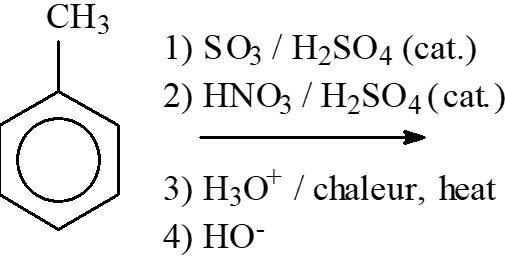
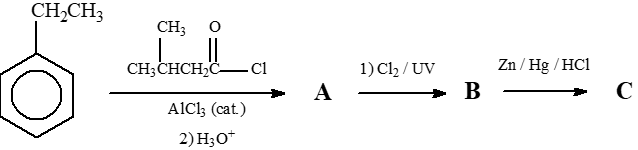
| | j | Provide products A, B and C in the following reaction sequence:
|
- Taking
into consideration the use of a blocking group, synthesize 2,6-dichlorobenzoic
acid starting from benzene. You
may use any single-carbon containing compound without synthesizing it. Provide the names of the electrophilic
aromatic substitution reactions used in the synthesis. Explain your strategy. Problem
15.15 is important, as well as the synthetic schemes on page 691.
- Taking into
consideration the use of a protecting group, synthesize 2-chloro-4-propylphenol
starting from phenol. You may use compounds
containing one (1) to four (4) carbon atoms without synthesizing them. Provide the names of the electrophilic
aromatic substitution reactions used in the synthesis. Explain your choice of strategy. Note
that problem 15.7 on page 679 is important.
|
| 11th edition | 12th edition |
| Section | Subject | Section | Subject |
| 15.1 | Electrophilic
aromatic substitution reactions | 15.1 | Electrophilic
aromatic substitution reactions |
| 15.2 | A general mechanism
for electrophilic aromatic substitution | 15.2 | A general mechanism
for electrophilic aromatic substitution |
| 15.3 | Halogenation of
benzene (omit the mechanism) | 15.3 | Halogenation of
benzene (omit the mechanism) |
| 15.4 | Nitration of benzene
(omit the mechanism) | 15.4 | Nitration of benzene
(omit the mechanism) |
| 15.5 | Sulfonation of
benzene (omit the mechanism) | 15.5 | Sulfonation of
benzene (omit the mechanism) |
| 15.6 | Friedel-Crafts
alkylation | 15.6 | Friedel-Crafts reactions (Sections 15.6A, 15.6B, 15.6C Limitations of Friedel-Crafts reactions - point 1 only) (solved problem 15.2 is
important) |
| 15.7 | Fridel-Crafts
acylation | 15.7 | Synthetic
applications of Friedel-Crafts acylations: The Clemmenson and Wolff-Kishner reductions (problem 15.5 A and B are
important) |
| 15.8 | Limitations of
Friedel-Crafts reactions (point 1 only) (solved problem 15.2 is
important) | 15.8 | Existing substituents direct the position of electrophilic aromatic substitution (solved problem 15.4 and problems 15.7 and 15.11 are
important) |
| 15.9 | Synthetic
applications of Friedel-Crafts acylations: The Clemmenson and Wolff-Kishner reductions (problem 15.5 B is
important) | 15.9 | Activating and deactivating effects: How electron-donating and electron-withdrawing groups affect the rate of an EAS reaction |
| 15.10 | Substituents can
affect both the reactivity of the ring and the orientation of the incoming
group (solved problem 15.3 and problem 15.7 are
important) | 15.10 | Directing effects in disubstituted benzenes (problem 15.12 is important) |
| 15.11 | How substituents
affect electrophilic aromatic substitution: A closer look (problem
15.9 is important) | 15.11 | Reactions of benzene ring carbon side chains |
| 15.12 | Reactions of the side
chain of alkylbenzenes | 15.12 | Synthetic
applications (solved problem 15.5 and problem 15.15 are important) |
| 15.13C | Oxidation of the side
chain |
|
|
| 15.14 | Synthetic
applications (solved problem 15.5 and problem 15.15 are important) |
|
|