Image
Extraction, recrystallization and analysis of caffeine from tea

Schedule
Detailed schedule and instructions for the prelab, the lab report and the required reading
This schedule is unofficial and subject to modifications.
Prelab            Report
Instructions
+
Supplementary Material
EvaluationRequired Reading - to be done before the experimentInstructions
+
Information
Evaluation
Lab Manual
by Turkewitsch
Lab Textbook
Macroscale and Microscale Experiments

5th edition by Williamson
First-year chemistry textbook
Chemistry:  The Central Science
13th edition by Brown, LeMay and Bursten
After having read the required reading and the procedure provided below, prepare a prelab as follows:

1. Prepare data tables following the example in the Chemistry Guide for the extraction of caffeine from tea (part 1)

2. Answer the following prelab question:

Why is sodium carbonate added to the tea leaves during the preparation of the aqueous tea solution (Part 1)? Provide an explanation with reactions showing how caffeine is extracted from an aqueous solvent to an organic solvent.  Be sure to provide the structures of the molecules in your reactions. Cite your sources.
The prelab for the entire experiment will be marked before the beginning of the lab session.
Section - Lab notebook & prelab assignment provides information on how to prepare your prelab.

Sub-section - Flow diagram provides a detailed description of the flow diagram.
Chapter 7 Extraction

Read about extraction - pages 135-145.

Read about the extraction of caffeine from tea - pages 162-163.

Read the Introduction (Extraction of caffeine from tea and Liquid-liquid extraction) provided on the previous Web page.
---
Hand in the report sheet at the beginning of the next lab period or one week after the lab work has been completed.

Paper copy only.
Report -
Extraction of caffeine from tea

Example flow diagram - recrystallization of crude caffeine


Safety Cleanup and disposal

All solutions and mixtures are to be placed in the designated waste receptacle for that purpose. Under no circumstances are the solutions or mixtures to be flushed down the drain.  If you are unsure of how to handle a solution, ask your professor or the lab technician.  Throw used rinsed test tubes in the glass waste box.


Experimental Procedures

Part 1. Extraction of crude caffeine from tea1
  1. To a 1000 mL beaker you will add 30 g of black or green tea leaves (approximately 10 sachets of tea) and 25 g of sodium carbonate.  To do so, weigh the weighing boat with the tea leaves.  Place the tea leaves into the 1000 mL beaker and reweigh the weighing boat.  The difference in weights provides the weight of the tea leaves added to the beaker.  This process is known as weighing by difference. Proceed in the same way for the sodium carbonate.
  2. Add 225 mL of boiling water.
  3. Mix well with a glass stirring rod. Be careful not to break the tea bags while stirring. Allow the mixture to infuse for 5 minutes.  Decant the tea into a 400 mL beaker. Press the tea bags with the base of a graduated cylinder to extract the tea solution from the tea bags, and then decant the tea into the same 400 mL beaker.
  4. To the hot tea leaves add another 50 mL of boiling water and then immediately decant and combine with the first extract.  Once again, press the tea bags with the base of a graduated cylinder to extract the tea solution from the tea bags. Very little additional caffeine is extracted by boiling the tea leaves. Place the used tea bags in the compost.
  5. Cool the aqueous solution to near room temperature.
  6. Extract twice (2X) with 30-mL portions of dichloromethane following the steps below:
    1. Transfer the aqueous solution to a separatory funnel and add the first 30-mL portion of dichloromethane.
    2. Do not shake the separatory funnel so vigorously as to cause emulsion formation. However, if it is not shaken enough the caffeine will not be extracted into the organic layer.  Use a gently rocking motion of the separatory funnel. Once complete, place it into a ring attached to a ring stand.
    3. Allow the layers to separate.
    4. Slowly drain the dichloromethane layer on the first extraction into a 250 mL beaker.
    5. Repeat these steps with the second 30-mL portion of dichloromethane.  Drain the dichloromethane and the emulsion layers into the 250-mL beaker containing the first extract.
  7. Dry the combined dichloromethane extracts and any emulsion layer with anhydrous calcium chloride.  Add sufficient drying agent until it no longer clumps together on the bottom of the flask.
  8. Carefully decant or filter the  dichloromethane solution through a funnel containing a silicon-impregnated filter paper into a pre-weighed and labeled beaker (250 mL).
  9. Wash the drying agent with a small portion (5 mL) of solvent and let the solvent evaporate for one (1) to three (3) days.
  10. After the drying period, weigh and examine the crystals. The residue of greenish-white crystals should weigh about 0.25 g. 
  11. Calculate yield.
Part 2. Recrystallization of crude caffeine2

Reread the recrystallization procedure to familiarize yourself with the steps of recrystallization. Little detail will be given during the experiment.

  1. Before beginning the recrystallization, place a bit of crude caffeine in a small vial for the TLC analysis.
  2. Note the exact mass of crude caffeine to be used in the recrystallization process. 
  3. To recrystallize caffeine, dissolve it in about 10 mL of hot acetone and transfer the solution to a small Erlenmeyer flask with a Pasteur pipette.
  4. While the solution is hot, add hexanes (this solvent is a mixture of isomers of hexane and isohexane) until the mixture becomes cloudy.
  5. Set the flask aside and allow it to cool slowly to room temperature.
  6. This mixed-solvent method of recrystallization depends on the fact that caffeine is far more soluble in acetone than in hexanes, so a combination of  the two solvents can be found where the solution is saturated in caffeine and will appear cloudy.
  7. Next, cool the mixture in an ice bath and collect the crystals by vacuum filtration with a Hirsch funnel.  Use a few drops of ice-cold hexanes to transfer and wash the crystals. 
  8. To obtain a second crop of crystals, transfer the filtrate into an Erlenmeyer, cool the mixture and collect the crystals by vacuum filtration.
  9. Weigh crystals once dry and calculate the appropriate yields.
Part 3. Analysis of caffeine

Three (3) analytical methods will be used:
  1. FT-IR Spectroscopy
    1. Follow Stéphane's instructions to obtain the spectra.
    2. Analyze the data.
  2. Melting point
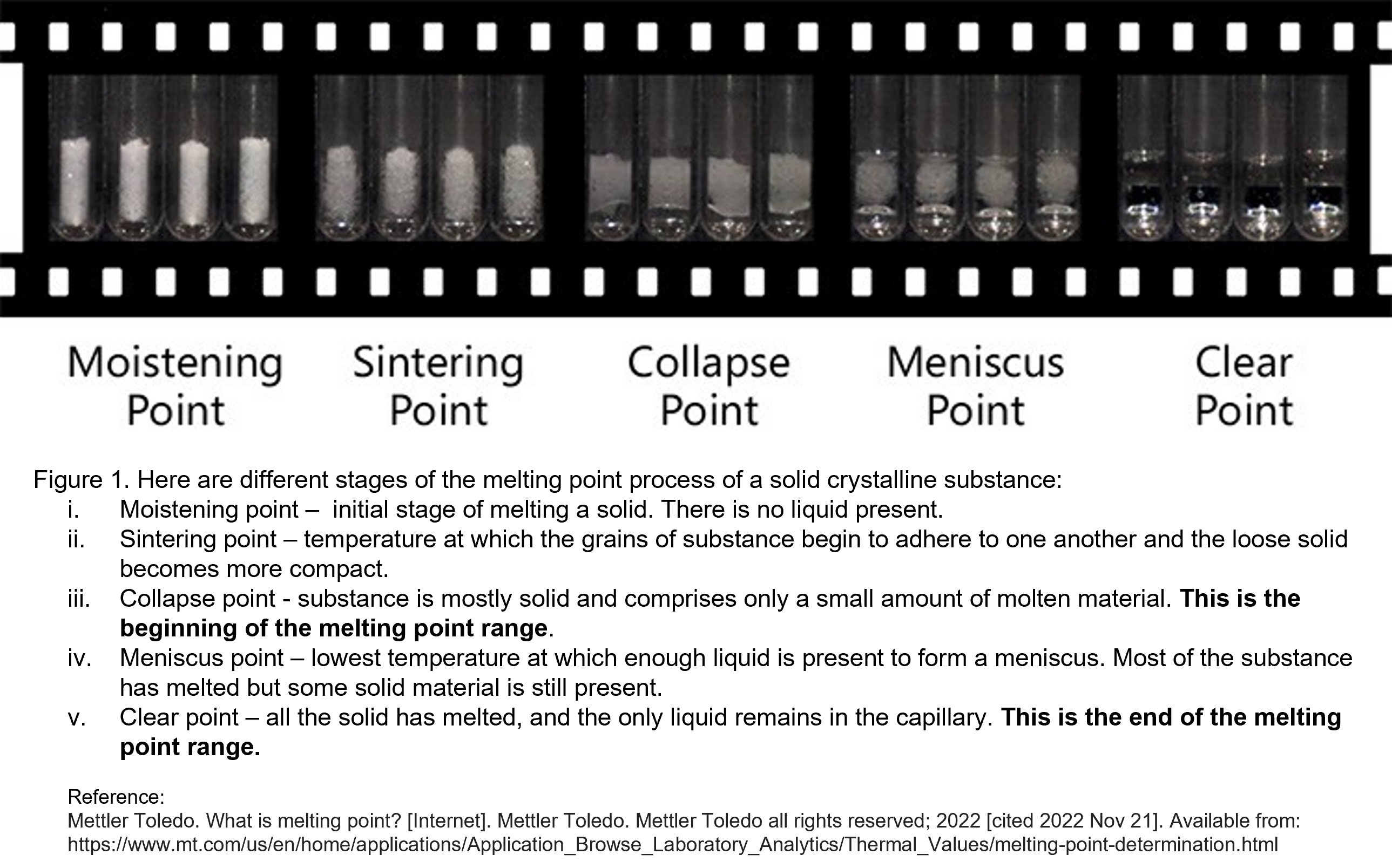
    1. Determine the melting point of recrystallized and standard caffeine using the melting point capillary apparatus (STUART SMP30). The different stages of fusion may be found in Figure 1 below. 
    2. Perform three (3) trials.
    3. Analyze the data.
  3. Thin-layer chromatography (TLC)
    1. Use a small plate (4 cm wide x 10 cm high) coated with silica gel.
    2. Analyze the crude caffeine, the recrystallized caffeine and the standard caffeine.
    3. Prepare 1 % solutions of these substances in 1 mL of ethanol.
    4. Develop the plate in a beaker covered with a watch glass containing 15 mL of the mobile phase (95 % ethyl acetate, 5% acetic acid).  
    5. Analyze the data. 
Stages of melting

References

  1. Williamson KL. Macroscale and microscale organic experiments. 5th ed. New York: Houghton Mifflin Company; 2003. Chapter 7, Extraction; p. 135 
  2. Williamson KL. Macroscale and microscale organic experiments. 5th ed. New York: Houghton Mifflin Company; 2003. Chapter 4, Recrystallization; p. 78