Infrared Spectroscopy and Refractometry
 (revised 15 Aug 2023)

Schedule
Detailed schedule and instructions for the prelab, the lab report and the required reading
This schedule is unofficial and subject to modifications.
Prelab Report
Instructions
+
Supplementary information
Evaluation Required Reading - to be done before the experiment Instructions
+
Information
Évaluation
Lab Manual
by Turkewitsch
Lab Textbook
Macroscale and Microscale Experiments
5th edition by Williamson
First-year chemistry textbook
Chemistry:  The Central Science
13th edition by Brown, LeMay and Bursten
Read Chapters 11 and 14.

Listen to the videos below.
The prelab for the entire experiment (Parts A and B) will be marked before the beginning of the lab session. ---
Chapter 11 Infrared Spectroscopy

AND

Chapter 14 Absorption Spectroscopy and Refractive Indices - read pages 299-301
--- Hand in the report sheet at the beginning of the next lab period or one week after the lab work has been completed.
OCLaRE report - IR Spectroscopy

Infrared Spectroscopy Videos for the Prelab

Introduction to infrared spectroscopy


IR spectra of hydrocarbons


 IR spectra practice


Experimental Procedures

During this experiment, you will be given one (1) unknown compound, and you must determine its identity using infrared (IR) spectroscopy and refractometry.  Your unknown compound is one from among the following: 

Part A. IR spectroscopy1
 
Follow Stéphane's instructions during this experiment. Take notes for your lab report.
 
Part B. Refractometry2
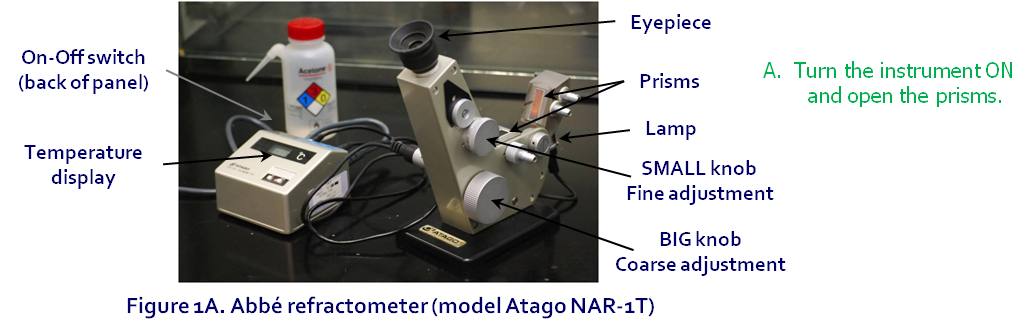
  1. Turn ON the Abbé refractometer (Figure 1A).
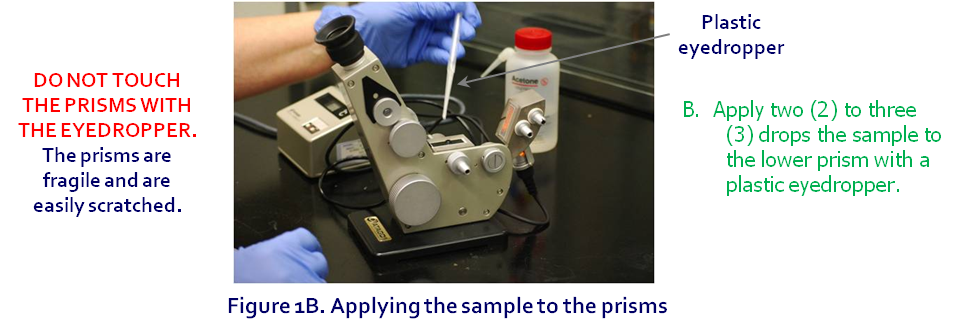
  2. Open the measuring prisms and apply two (2) to three (3) drops of the sample to the lower prism using a plastic eyedropper.  The prisms are fragile. DO NOT TOUCH the prisms with the eyedropper so as not to scratch them (Figure 1B).
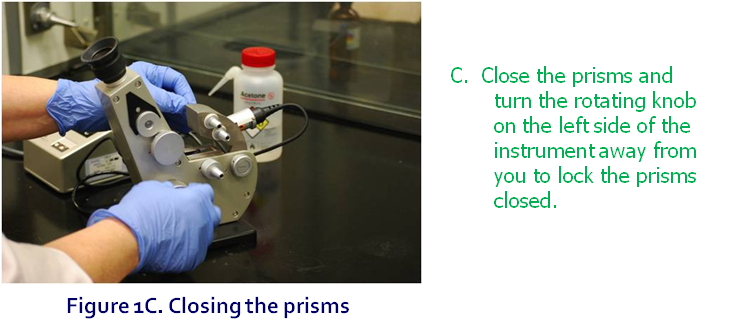
  3. Close the prisms.  Turn the rotating knob on the left side of the instrument away from you to lock the prisms closed (Figure 1C).
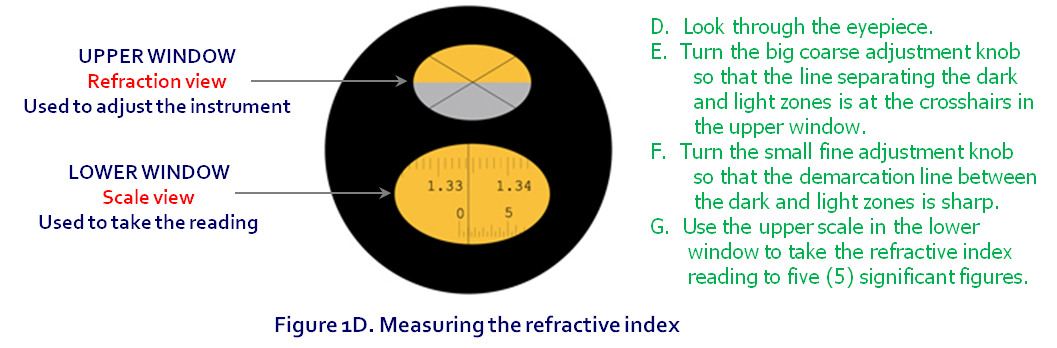
  4. Look through the eyepiece.  You will see two (2) windows. The upper window is the refraction view and is used to adjust the instrument. The lower window is the scale view and is used to take the refractive index reading (Figure 1D).
  5. Looking at the upper window, turn the BIG coarse adjustment knob so that the line separating the dark and light zones is at the crosshair (the X) in the upper window (Figure 1D). 
  6. Next, turn the SMALL fine adjustment knob to make the demarcation line between the dark and light zones as sharp as possible (Figure 1D).
  7. Now use the BIG coarse adjustment knob to bring the demarcation line exactly to the middle of the crosshair (Figure 1D).
  8. In the lower window two (2) scales with numbers are visible:  an upper one and a lower one.  The upper one is used to measure the refractive index (Figure 1D).  As an aside, the lower scale is the Brix scale used for measuring the concentration of sucrose solutions.
  9. Using the upper scale, take the refractive index measurement to five (5) significant figures (Figure 1D).  Note the temperature.
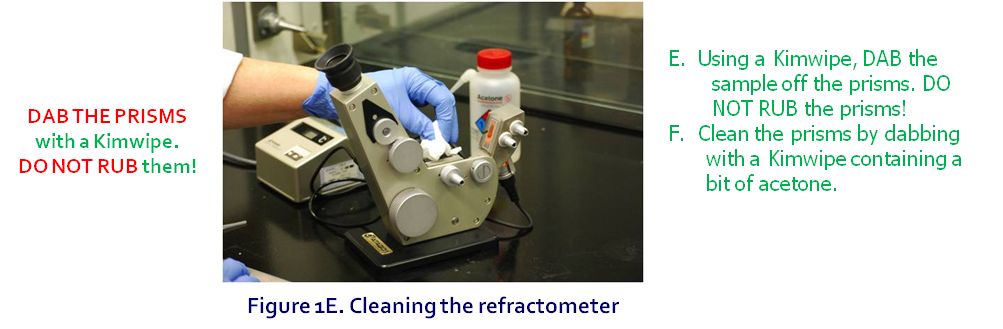
  10. When the measurement is complete, open the prisms. Use a Kimwipe tissue to dab the sample off the prisms (Figure 1E).  DO NOT RUB the prisms as they are fragile!
  11. Next, clean the prisms by dabbing with a Kimwipe containing a bit of acetone (Figure 1E).
  12. Do three (3) trials.
  13. Correct the refractive index to 20°C.
  14. Do the necessary calculations to analyze the data.
TurnONRefractometer
ApplyingSubstanceRefractometer
ClosingPrismsRefractometer
TakingMeasurementRefractometer
CleaningRefractometer
Figure 1. Steps to using the Abbé refractometer to measure the refractive index (nD) of a substance

References

  1. Williamson KL, Minard R, Masters KM. Chapter 11 Infrared Spectroscopy. In: Macroscale and microscale: organic experiments. 5th edition. Boston: Houghton Mifflin; 2007. p. 231.
  2. Williamson KL, Minard R, Masters KM. Chapter 14 Ultraviolet Spectroscopy, Refractive Indices and Qualitative Instrumental Organic Analysis. In: Macroscale and microscale organic experiments. 5th ed. Boston: Houghton Mifflin; 2007. p. 293.