Image
Part 1. Synthesis of aspirin

Schedule
Detailed schedule and instructions for the prelab, the lab report and the required reading
This schedule is unofficial and subject to modifications.
WeekDatePrelab            Report
Instructions
+
Supplementary Material
EvaluationRequired Reading - to be done before the experimentInstructions
+
Information
Evaluation
Lab Manual
by Turkewitsch
Lab Textbook
Macroscale and Microscale Experiments

5th edition by Williamson
First-year chemistry textbook
Chemistry:  The Central Science
13th edition by Brown, LeMay and Bursten
1
19 Aug.

Part 1. Synthesis of aspirin

After having read the required reading given in this table and the procedure provided below, prepare a prelab as follows:

1. Prepare data tables following the Chemistry Guide.

2. Answer the following prelab question: Calculate the theoretical yield of aspirin from the quantities provided in the procedure. For the molar masses of the compounds, use the Handbook of Chemistry and Physics. For the density values of the compounds, use the Handbook or the values on the bottles. Cite your sources!!
The prelab for Part 1 will be marked before the beginning of the lab session.
Section - Lab notebook & prelab assignment provides information on how to prepare your prelab Chapter 41 Acetylsalicylic acid (Aspirin)

AND

Read the introduction to the synthesis of aspirin provided above
---
Hand in the report sheet at the beginning of the next lab period or one week after the lab work has been completed.
Lab Report Sheet
Synthesis of Aspirin

Safety

Cleanup and disposal

All solutions and mixtures are to be placed in the designated waste receptacle for that purpose. Under no circumstances are the solutions or mixtures to be flushed down the drain.  If you are unsure of how to handle a solution, ask your professor or the lab technician.  Throw used rinsed test tubes in the glass waste box.


Experimental procedure

Synthesis of aspirin
1
  1. On a hot plate, prepare a hot-water bath in a 100-mL beaker.  Insert a thermometer (secured with a thermometer clamp) into the beaker containing the water, add a magnetic stir bar, and maintain the hot-water bath at 90°C with gentle stirring.  The temperature of this bath must not go above 90°C!
  2. Place a reaction tube (microkit) in a small beaker to keep it upright during the weighing process. Place the reaction tube in the small beaker on the analytical balance and rezero the balance.
  3. To a reaction tube add approximately 276 mg of salicylic acid.  Add 0.6 mL acetic anhydride with an eppendorf pipette. Upon adding the acetic anhydride, wash down the sides of the reaction tube so that the reactants are at the bottom.
  4. Add two drops of phosphoric acid.
  5. Mix the contents of the tube, heating gently in the hot-water bath until all the salicylic acid has dissolved.
  6. Add ONE boiling stone (obtain from your professor).
  7. Clamp the reaction tube in the hot water bath and heat for 5 minutes.  Observe!
  8. Remove the reaction tube from the hot-water bath.  Let it cool to the touch and add 0.4 mL of room-temperature distilled water to decompose the excess acetic anhydride.  Observe the decomposition reaction!
  9. Add another 0.6 mL of room-temperature distilled water. Mix once.
  10. Allow the reaction mixture to cool at room temperature. Do not mix the contents !
  11. If crystallization has not occurred, scratch the sides of the reaction tube in an ice bath to induce the formation of crystals.
  12. Once crystals are present, place the reaction tube in the ice bath to allow complete crystallization to occur. Do not mix the contents!
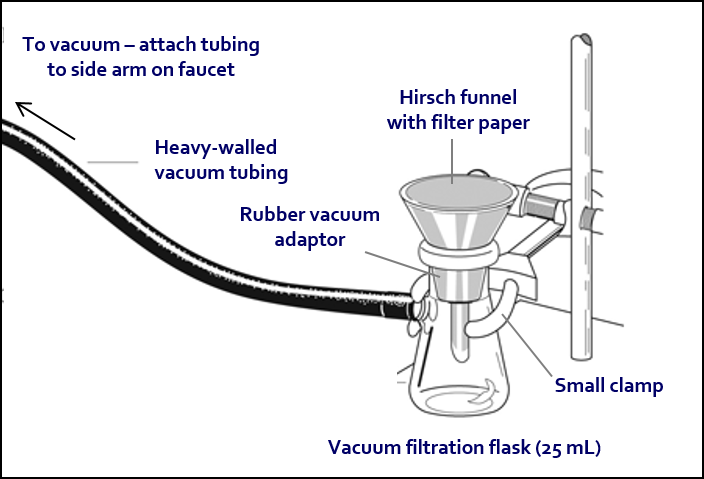
  13. Collect the crude aspirin crystals by vacuum filtration (see Figure 1) on a Hirsch funnel according to the following steps.
    1. Place a filter paper (preweighed on a labeled watch glass) in the Hirsch funnel and wet it with a very small amount of ice-cold water.
    2. Insert the funnel into the filtration flask placing a rubber vacuum adapter in between the Hirsch funnel and the filtration flask. Connect the filtration flask to the side arm of the faucet with a vacuum tube.
    3. Open the faucet to have a good flow of water.
    4. Using a boiling stick, a spatula or an eyedropper, transfer the mixture of solvent and crystals onto the filter paper contained in the Hirsch funnel. Use several small portions of ice-cold water to help in the transfer of the crystals and to rinse the crude aspirin in the Hirsch funnel.
    5. To eliminate as much of the solvent as possible and to partially dry the crystals, maintain the suction for about 5 minutes.
  14. Transfer the crystals with the filter paper onto the watch glass (preweighed and labeled).  Remove the boiling stone.
  15. Come back during the week to examine and weigh the crude aspirin crystals. You must come back on your own time. The technicians are available during working hours from 8 am to 4 pm, Monday to Friday.
  16. Calculate the percentage yield.
  17. Next week you will purify the crude aspirin by recrystallization.

Vacuum filtration setup no filter guard
Figure 1. Vacuum filtration setup.2  Clamp small filter flask containing Hirsch funnel to prevent spills and the breakage of glassware.

References

  1. Williamson KL, Minard R, Masters KM. Chapter 41 Acetylsalicylic acid (aspirin). In: Macroscale and microscale: organic experiments. 5th edition. Boston: Houghton Mifflin; 2007. p. 569.
  2. Williamson KL, Minard R, Masters KM. Chapter 4, Recrystallization. In: Macroscale and microscale: organic experiments. 5th edition.Boston: Houghton Mifflin; 2007. p. 78.