Thin-Layer Chromatography
 (revised 13 Sept. 2024)

Schedule

Detailed schedule and instructions for the prelab, the lab report and the required reading
This schedule is unofficial and subject to modifications.
Prelab Report
Instructions
+
Supplementary information
Evaluation Required Reading - to be done before the experiment Instructions
+
Information
Evaluation
Lab Manual
by Turkewitsch
Lab Textbook
Macroscale and Microscale Experiments
5th edition by Williamson
First-year chemistry textbook
Chemistry:  The Central Science
13th edition by Brown, LeMay and Bursten
To complete your prelab, answer the question below after having read the required reading and listened to the video.  There are no data tables to prepare.

Prelab question: A mixture of naphthalene, butanoic acid and phenyl acetate is applied to a silica gel plate, which is then developed in dichloromethane. Draw the developed TLC plate showing the position of each of the three substances on the plate. An example of a developed TLC plate may be found in Figure 8.10 on page 182 of Chapter 8. Which compound has the highest Rf value and which has the lowest? Describe your reasoning. Cite your sources. Be sure to cite the original sources. 

Here is a video that explains nicely the prinicples of TLC:


Part A
.  Solution preparation

Please bring along to the lab all that you need to take notes, to study and do problems. Since the solution preparation will only take one period, a lecture course will take place for one of the periods.
The prelab for the entire experiment (Parts A, B, C and D) will be marked before the beginning of the lab session. Section - Sections of a lab report

Sub-section - Abstract provides information on how to prepare an abstract.
Chapter 8 Thin-Layer Chromatography --- Hand in the report sheet at the beginning of the next lab period or one week after the lab work has been completed.
OCLaRE TLC Report
Part B. Developing tank and plate preparation

Part C. Application of substances

Part D. Development and visualisation

Please bring along all that you need to study and do problems. During plate development a study period will take place.  


Experimental Procedures1,2

Ensure that a clean spatula and capillary are used for each sample.  This avoids cross-contamination of the samples.  Thin-layer chromatography (TLC) is very sensitive to contamination, and so I will pay very close attention to plate contamination in marking the laboratory reports.

A. Solution preparation
  1. For each of the four (4) standards (acetylsalicylic acid (ASA), acetaminophen, ibuprofen and caffeine), prepare a 1% solution in about 1000 µL of ethanol (EtOH) in four (4) different small vials.  These standard solutions will serve as a reference for the identification of your unknown. 
    1. Weigh the appropriate mass of each substance in a small labeled vial.
    2. Add the appropriate volume of ethanol with an eppendorf pipet.
  2. In separate vials, prepare a 1% solution of each unknown analgesic tablet (A et B) in 1000 µL of ethanol.
    1. Grind the unknown in a mortar with the pestle.
    2. Weigh the appropriate amount of substance in a small labeled vial.
    3. Add the appropriate volume of ethanol using an eppendorf pipet.
    4. Wash and dry the mortar and pestle and repeat these same steps for the second unknown analgesic tablet. 
B. Developing tank and plate preparation
  1. To prepare the developing tank, begin by preparing 300 mL of the mobile phase (eluant) with a composition of 95 % ethyl acetate and 5 % acetic acid in a graduated cylinder.
  2. Pour the mobile phase in the developing tank.
  3. Line the sides of the tank with filter paper in order to saturate the internal environment with the mobile phase.
  4. Place the lid on the developing tank.
  5. The tank will be ready to use once the TLC plates have been prepared.
C. Application of substances

Wear gloves at all times and manipulate the silica gel TLC plates by grasping the edges only
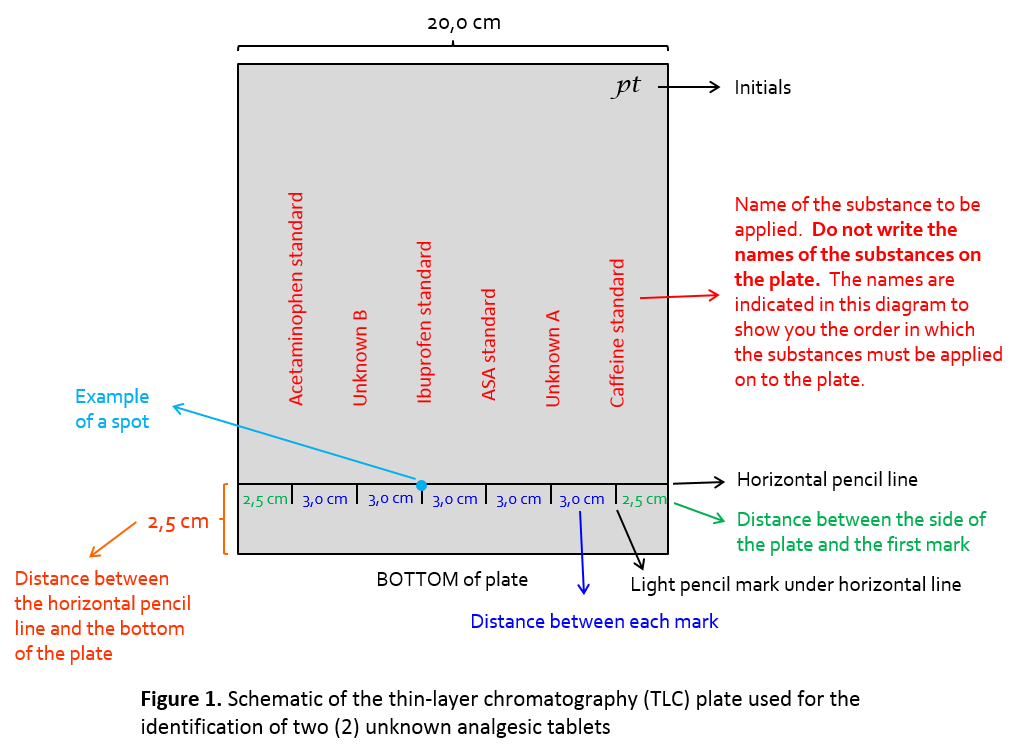
. Figure 1 presents a schematic of the TLC plate. Also see Figure 8.5, page 180 in Macroscale and Microscale Organic Reactions by Williamson.

  1. With a pencil, draw a light horizontal line 2.5 cm from the bottom of the silica gel plate.  Divide this horizontal line into six equal lanes that are 3.0 cm apart starting 2.5 cm from the left edge of the plate.  Place light pencil marks under the horizontal line to indicate the lanes.  This TLC plate is now ready to be spotted with the standard and unknown substances. 
  2. To apply a sample on a TLC plate:
    1. Plunge a clean capillary into one of the sample solutions for a few seconds. Remove the capillary.
    2. Apply superposed drops, no more than 3 mm in diameter, of the sample on to the plate in the lane reserved for the sample (Figure 1).  To apply a sample with a capillary tube, touch the end of the capillary very lightly and quickly on to the absorbent surface of the plate.  The silica gel surface of the plate is very fragile!  Be careful not to break it with the capillary! 
    3. Let the solvent dry in between applications.
    4. Apply three (3) superposed drops for acetaminophen, acetylsalicylic acid, caffeine, unknown A and unknown B samples, allowing the spots to dry in between applications.
    5. For ibuprofen apply five (5) superposed drops, allowing the spots to dry in between applications.
    6. Before applying the samples to the actual plate, you may practice your application technique with small pieces of TLC plate that we have on hand for this purpose.
    7. Verify whether you have applied enough substance in each lane by visualizing the plate in a UV chamber before placing it in the developing tank.

D. Development and visualization

  1. Place the TLC plate in a quasi vertical position in the developing chamber and close the chamber.
  2. When the solvent front has migrated to about 1 cm from the top of the plate, remove the plate from the tank and rapidly mark the solvent front with a pencil.  The solvent evaporates quickly, so you must be quick about marking the solvent front.
  3. Leave the plate in the hood to dry (the mobile phase smells very strongly).
  4. Return to the lab sometime during the coming week to read the plate.
  5. Upon returning, place the plate in the UV chamber, with the UV light on, mark the center of each spot and lightly circle the spots with a pencil.  Wear gloves when working under the UV lamp!
  6. After measuring the appropriate distances, calculate the retention factors (Rf).  See Figure 8.10, page 182 in Macroscale and Microscale Organic Reactions by Williamson.  Analyze the accuracy of the results. 
  7. Determine the composition of each unknown analgesic tablet and identify whether the unknown analgesic tablet is:  Motrin, Aspirin, Tylenol, Tylenol Daytime Relief or Anacin.
Image TLC plate

References

  1. Schoffstall AM, Gaddis BA, Druelinger ML. Chapter 1 Technique K. In: Microscale and miniscale organic chemistry laboratory experiments. 2nd ed. New York: McGraw-Hill Higher Education; 2004. p. 92.
  2. Williamson KL, Minard R, Masters KM. Chapter 8 Thin-layer Chromatography. In: Macroscale and microscale: organic experiments. 5th edition. Boston: Houghton Mifflin; 2007. p. 172.