Molar mass of magnesium
(revised 5 Jun 2024)
Objectives
- To use the
stoichiometry of a simple chemical reaction to determine the molar mass of
magnesium, a direct application of the gas law.
- To calculate the partial pressure of H2
gas produced in this experiment using two (2) corrections: one that
takes into account the vapor pressure of water and another that
converts the height of the column of aqueous solution to the
corresponding height of a column of mercury.
- To assess the precision of the experiment using
standard deviation and the accuracy using percentage error.
Introduction
Background and theory
Throughout
many years of experimentation, scientists have determined the four variables
that must be known in order to characterize the physical state of a gas. These four variables are pressure, P;
temperature, T; volume, V and the amount of gas, usually in moles, n.1 It has
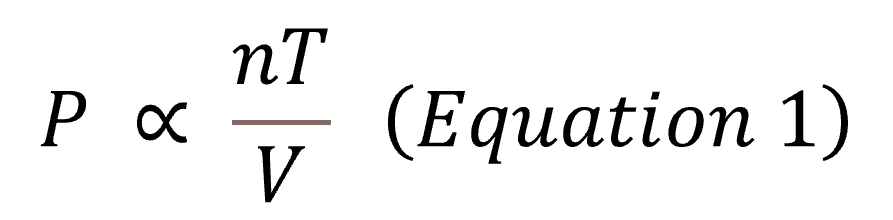
been shown that the pressure (P) of any sample of an ideal gas is inversely
proportional to its volume (V) and directly proportional to its absolute
temperature (T) and to the number of moles (n)
of the gas present in the sample (Equation 1).
In
equation
1 is read, “pressure is proportional to the number of moles
of a gas, to the temperature of a gas, and to 1/V of a gas.” A more convenient way to express this
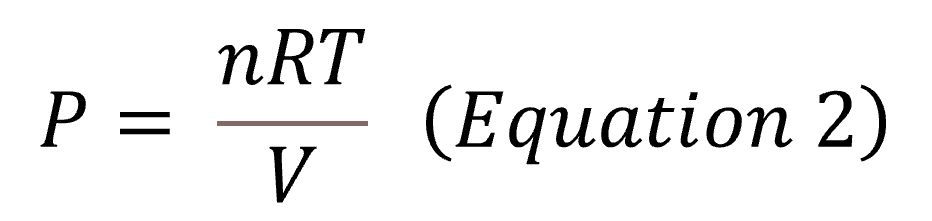
relationship is in the form of an equation (Equation 2):
In this
form, R represents the “proportionality constant” which is referred
to as the ideal gas constant. A
more familiar version of this equation is the ideal gas equation or the
ideal
gas law, shown below (Equation 3).2
An ideal gas
is a hypothetical gas in which the molecules do not occupy a volume and do not
form any intermolecular interactions.1 No gas is ideal, however, at normal
temperatures and pressures, the ideal gas equation is a close approximation. The value of R
depends on the units for the variables in the equation, however, the two most
common values are 0.0821 L*atm/mol*K or 8.314 J/mol*K.1 Note that the ideal gas
law requires that temperatures be in Kelvin, K.
Experimental details and calculations
The object
of the present experiment is to determine the molar mass of magnesium by
measuring the amount of hydrogen (H2) gas produced when a known mass
of magnesium metal dissolves in hydrochloric acid. The chemical reaction being
performed in this experiment is that between magnesium metal and hydrochloric
acid to produce hydrogen gas and magnesium chloride (which is soluble in water)
(Equation 4).

The magnesium
metal oxidizes to the magnesium ion and the hydrogen ion is reduced to the
diatomic gas. Hydrochloric acid (HCl) is present in excess, so each mole of
magnesium should lead to one mole of H2 gas.
The H2
produced by this reaction will be collected in a eudiometer tube by downward
displacement of the dilute aqueous acid solution (hereafter simply referred to
as the aqueous solution), and its volume
measured from the scale on the side of the eudiometer tube. See Figure 1 below for the reaction setup. The reaction
temperature under which the H2 gas is collected is determined by
measuring the water temperature in the
beaker after the reaction is complete. The distance from the water level in
the beaker to the solution level inside the eudiometer is also obtained. This is referred to as the "height
of the column of aqueous solution."
Finally, the atmospheric pressure
is noted using the barometer in the lab.
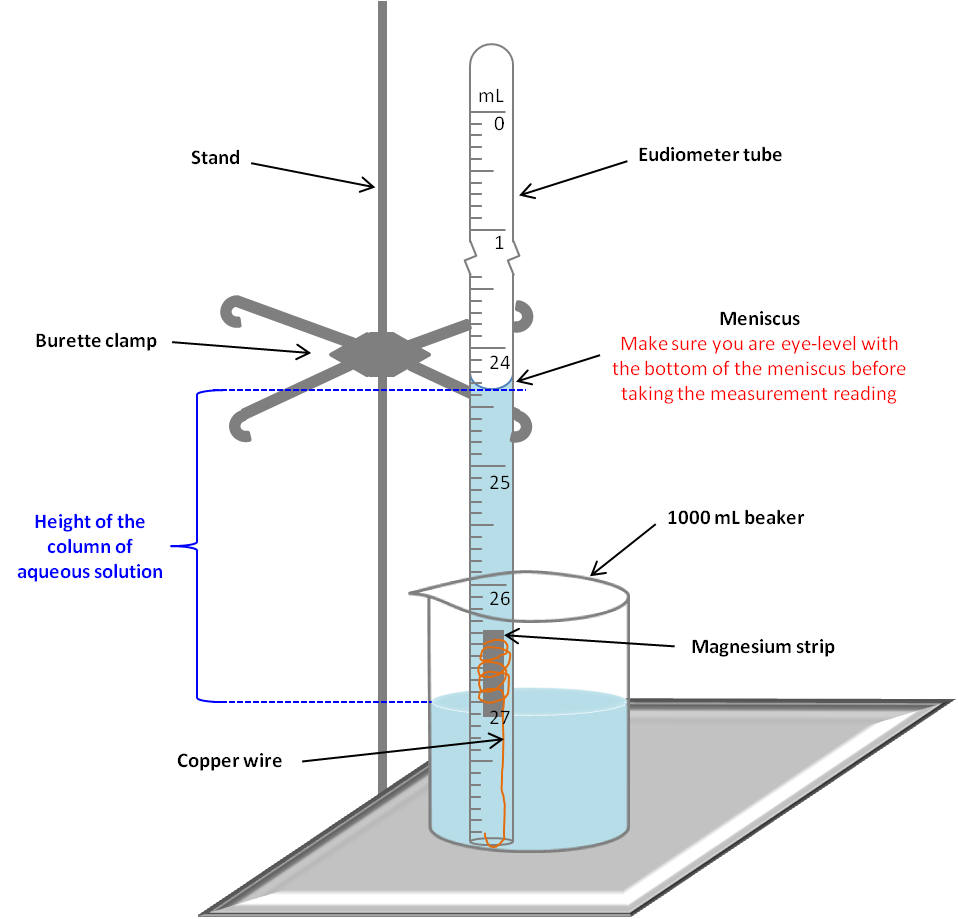 |
| Figure 1. Setup for the molar mass of magnesium experiment |
To calculate
the partial pressure of H2 gas in the eudiometer tube, two corrections must be taken into account.
- The first
pressure correction is necessary because the H2 gas is collected
above an aqueous solution, and, thus, a small amount of water vapor is present
in the hydrogen gas. In fact, liquid water and water vapor are always in
equilibrium above any aqueous solution in a closed container, even at
temperatures below the boiling point of water.
Since water vapor is not created in this reaction (Equation 4), the
presence of water vapor in the hydrogen gas must be corrected for. To do so, the
vapor pressure of water at the reaction temperature
must be subtracted from the atmospheric pressure (total pressure) of the
laboratory using Dalton’s law of partial pressures as shown in Equation 5.2

Since the
reaction between metals and acids is exothermic, the reaction temperature is used to find the vapor pressure of water in
the above equation 5. Remember, is the temperature in the beaker AFTER the
reaction has occurred. A table of these vapor pressures at different
temperatures may be found in the Handbook
of Chemistry and Physics.
- The second
pressure correction is due to the column of aqueous solution remaining in
the eudiometer tube at the end of the reaction. Because the level of solution inside the
tube is higher than the water level in the beaker at the end of the reaction,
the pressure of gas inside the tube is lower than the atmospheric pressure (how
do you know this?). You will need to convert the height of the column of aqueous solution
in the eudiometer tube to the corresponding height of a column of mercury. Then,
since mmHg is a unit of pressure, it may be simply subtracted from the pressure
of the H2 gas obtained after the first correction.
To convert the height of the column of aqueous solution
to the corresponding height of a column of mercury (Hg), the differing
densities of mercury and water must be taken into account. The following equation
(Equation 6) relates the pressure due to a column of liquid to its height and
density.2
P is the pressure due to a column of liquid; g is
the constant acceleration due to gravity; rho is the
density of the liquid; and h is the height of the column of
liquid. Since we want to relate the pressure of the column containing the
aqueous solution to the pressure of a column of mercury, the acceleration due
to gravity on both sides of the equation cancels out and a more useful for the equation
is given by (Equation 7):

Solving for hHg in
Equation 7 gives the height of a corresponding column of mercury. Do not forget to convert the height of the
column of mercury into millimeters. This
value is now subtracted from the pressure of the H2 gas corrected
for the presence of water vapor (first correction).
In
summary, to calculate the partial pressure of H2 gas for each trial,
the vapor pressure of water and the pressure correction for the conversion of
the height of the column of aqueous solution to the corresponding height of a column
of mercury must both be subtracted from the total atmospheric pressure.
Once the pressure
of H2 gas has been calculated, the number of moles of H2
gas formed by this reaction can be calculated using the ideal gas equation (Equation
3). From the stoichiometry of the
reaction, the number of moles of magnesium can be obtained, and hence its molar
mass may be calculated.
Since a
minimum of three trials will be performed, the average molar mass may be calculated.
In addition, the precision of the results may be determined by calculating the
standard deviation. By comparing the average
experimental molar mass to the theoretical value found in the periodic table,
the percentage error may be calculated, and, thus, the accuracy of the observed
value determined.
Safety
Wear safety glasses, lab coat and gloves. Work
cautiously with concentrated hydrochloric acid (HCl), because it can cause
serious bu
Procedure
See Figure 1 above for the experimental setup used in this experiment. Fill
a 1 L beaker about 3/4 full of tap water. It is best if the water temperature is
approximately that of room temperature. Verify
this with a thermometer while you continue your preparation.
Clean
a 4 to 5 cm strip of Mg ribbon by rubbing on fine emery cloth. Why?
Wipe clean and
weigh accurately on an analytical balance. Record the mass
with the correct number of significant figures and units. Coil
the weighed strip of Mg ribbon around one end of a piece of Cu wire. Add
approximately 8 mL of concentrated HCl to a eudiometer tube. Work CAREFULLY AND
SLOWLY! The concentrated HCl can cause
serious burns! With
your distilled water wash bottle, wash down any acid on the walls of the
eudiometer tube. This will require only
about 2 mL of water. Insert
the Mg ribbon attached to the Cu wire into the eudiometer tube and wrap the
long end of the Cu wire around the end of the eudiometer tube. This will hold the Mg ribbon about 5-10 cm
into the tube.
Slowly
fill the eudiometer tube as full as possible with distilled water, by holding
the tube on a slight angle. Quickly place your thumb or index finger over the
end of the tube and invert it into the beaker. Make sure that the eudiometer
tube sits on the bottom of the beaker. The
concentrated HCl will diffuse down the tube (why?) and react with the Mg (or your
finger if it is still there!). Thus it is
important to invert and clamp the tube quickly. Immediately,
place a thermometer in the beaker. This
will be used to measure the reaction temperature below. Record your observations. After
the reaction is complete, without changing the position of the eudiometer,
position a ruler to measure the distance (in millimeters) from the water level
in the beaker to the solution level inside the eudiometer tube. This is referred to as
the height of the column of aqueous solution in the report sheet and in the descriptions of the
calculations. Record the values. The height of the column of aqueous solution may be obtained in one of
two ways: - Measure
the height (in millimeters) of the water level inside the beaker, and then the
height (in millimeters) of the solution level inside the eudiometer tube and
subtract the two values.
- Or
position a clear ruler so that 0.00 mm begins at the top of the water level in
the beaker. Position yourself so that you are eye level with the meniscus in
the tube and look through the clear ruler to measure the height (in
millimeters) of the solution in the eudiometer tube.
Measure
the gas volume using the graduations and units on the eudiometer tube. Also
record the reaction temperature by measuring the water temperature in the
beaker, and the atmospheric pressure. Record these values with the
correct number of significant figures
and the correct units. Perform
at least two more trials for a minimum of three trials. Cleanup
Discard the liquids into the sink under a stream of running water. Clean
all labware with soap and water, and rinse well with tap water. Once all
the soap residues gone, rinse once with distilled water. There is no need
to dry the inside of the glassware with a paper towel.
References
- Brown TL, Lemay HE Jr, Bursten BE, Murphy CJ, Woodward PM, Stoltzfus MW, Lufaso MW.
Chemistry: The Central Science. 14th
ed. New York: Pearson;
2018
- Petrucci RH, Herring, FG, Madura JD, Bissonnette C.
General Chemistry: Principles and Modern Applications. 11th ed.
Toronto, Canada: Pearson Canada, Inc.; 2017