When a solution of strong acid is mixed with a strong base, the following
reaction occurs:
H3O+
(aq) + OH
-
(aq)
2 H2O
This neutralization reaction has an equilibrium constant of about 10-14
at room temperature, so that the reaction can be considered to proceed
completely to the right using up whichever ion is present in lesser amount and
leaving the solution either acidic or basic depending on whether H+
or OH-
was in excess.
Since the reaction is essentially quantitative, it can be used to determine the
concentrations of acidic or basic solutions. A frequently used procedure
involves the titration of an acid with a base. Titration
is the technique used to accurately measure, with a burette, the volume
of a solution required to react with another substance. During a
titration, a basic solution is added from a burette to a measured volume
of acid solution until the number of moles of OH-
added is equal to the number of moles of H3O+
ion present in solution. This point, at which the number of moles of acid equals the number of moles of base, is called the equivalence point.
In other words, stoichiometrically equivalent quantities of acid
and base are present in the solution at the equivalence point. Using the volume of the solution of base added, the concentration of the acid solution may be calculated.
The equivalence point of the titration can be estimated by a
chemical called an indicator. Thus,
it is important to remember that the equivalence point of a titation is
a theoretical point. It can be estimated by observing some
physical change associated with the condition of equivalence, such as
the color change of an indicator (which is termed the end point) or the precipitation of a substance. The indicators used are weak acids or bases that
change color with H3O+
concentration changes. The point at which an indicator changes color is the endpoint of the titration. The [H3O+] at the equivalence point determines which indicator one should used.
If the solution titrated has an endpoint at [H3O+] = 10-7M
(strong acid-strong base titration) an indicator with a KIn
of 10-7
would be used.
A very commonly employed indicator is phenolphthalein, which is colorless in
acidic solution and pink above a [OH-]= 10-9 M. Its easily observable color change allows it to be used to titrate strong and weak acids. The change in [H3O+] for a strong acid at the endpoint is so large that the error in using an indicator with a KIn
of 10-9
rather than a 10-7
indicator is insignificant. For weak acids, such as the ones employed in this
experiment, the phenolphthalein indicator may also be used because the endpoints are between a [H3O+] = 10-7M and 10-9M.
Data analysis
In Part 1 of this experiment, the concentration of a NaOH solution will be
accurately determined. The
process of determining the concentration of a solution is called standardization.
The NaOH solution will be standardized by titrating it against a
certain mass of a very pure sample of potassium hydrogen phthalate,
KHC8H4O4 (often
abbreviated KHP). KHP is a monoprotic acid, and, therefore, has only one acidic (ionizable) hydrogen
bonded to an oxygen atom. The balanced equation for the neutralization of KHP is:
KHC8H4O4(aq) + NaOH (aq)
KNaC8H4O4(aq) + H2O (aq)
The number of moles of KHP may be calculated from the mass of KHP used. When NaOH is titrated against KHP, an equal number of moles of
KHP and NaOH are present at the equivalence point of the titration. In other words, at the equivalence point:
Moles KHP = Moles NaOHThus,
knowing the number of moles of NaOH and the volume of NaOH added to
reach the equivalence point, it is possible to calculate the molarity
of the NaOH solution.
In Part 2 of this
experiment, the unknown acid is titrated with the standardized NaOH
solution, of which you now accurately know the concentration. Using the
volume of NaOH solution required to neutralize the mass of unknown acid and
the accurate concentration of the NaOH solution, it is possible to
calculate the moles of NaOH at the equivalence point. Then using
the moles of unknown acid at the equivalence point and the mass of the
unknown acid, the gram-equivalent weight (GEW) of the unknown acid may be calculated. The GEW of
an acid is the amount (mass) of acid that gives 1 mole of hydronium
ions. To
determine the number of ionizable (acidic) hydrogen atoms (also called acidic protons) present in
the unknown acid, the GEW of the unknown acid may be compared to the
true molar mass of the unknown acid once its identity has been
determined. To determine the identity of your unknown acid,
compare your results with the possible unknown acids listed below. Do
not forget to also compare the physical properties of color and
crystal shape of your unknown acid with the possible unknown acids
provided.
Possible unknown solid acids for this experiment are :
d,l-Mandelic acid
Citric acid
Succinic acid
Maleic acid
Prelab assignment
Prepare a table of physical properties for potassium hydrogen phthalate, as well as all the possible unknown acids. Include in this table: the structure
(identify the acidic protons in a different color), the molar
mass, the crystal form and color, the number of ionizable protons and
the GEW.
Write the balanced equation for the neutralization of KHP with the structures of KHP and its conjugate base.
For part 1, calculate the mass of dry KHC8H4O4 required to give a titration volume of 15 mL of 0.100 M NaOH.
Do not forget to provide your sources.
Safety
Use pipetting aids and wear your safety glasses. NaOH is not only caustic but
causes irreversible damage to eyes.
Correct Titration Technique
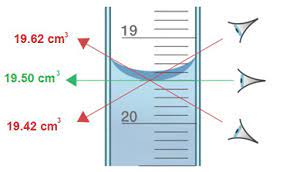
Please avoid parallax by
placing your eye level precisely parallel to the meniscus level (Figure
1).
Listen
to the video below (Figure 2). Note the correct positioning of
the hands and the burette
for titration and manipulating the stopcock. You must
manipulate the stopcock with your left hand if you are right-handed.
Pull the stopcock in against the taper each time you turn it.
This avoids loss of liquid due to improper positioning of
the
stopcock. With the right hand, swirl the flask continuously until
one drop of titrant (NaOH) causes a color change that persists
throughout the entire solution.
Figure 1. The correct method to read a burette1
Figure 2. Video describing the correct titration technique2
Procedure
Part 1. Standardization of NaOH
Obtain four (4) clean, dry Erlenmeyer flasks (250 mL). Label them.
Using the analytical balance, tare Erlenmeyer flask 1. Accurately weigh into Erlenmeyer flask 1 enough dry KHC8H4O4
to give a titration volume of 15 mL of approximately 0.1 M NaOH. You performed this
calculation in your prelab.
Record the exact mass of KHC8H4O4.
Add 25 mL of distilled H2O using a graduated cylinder. Accurately weigh KHC8H4O4 into
each of the other Erlenmeyer flasks (2, 3 and 4) and add 25 mL of
distilled water. Next, draw into a clean 250-mL beaker about 100 mL of
NaOH solution
(approximately 0.100 M). Fill the burette with the NaOH solution using
a funnel and record the
initial volume of the burette. Add 2 drops of phenolphthalein
to Erlenmeyer flask 1 and titrate the potassium hydrogen phthalate
with the
NaOH solution.
Record the final volume of NaOH in the burette after the titration is
complete.
Repeat for Erlenmeyer flasks 2, 3 and 4.
Verify with your instructor. Calculate the accurate concentration of
the NaOH solution as described
in the Data Analysis section.
Part 2. Determination of GEW of an unknown solid acid
Obtain an unknown acid and
record the unknown number in your prelab notebook.
Obtain four (4) clean, dry
Erlenmeyer flasks (125 mL). Label them.
Using the analytical balance, accurately
weigh an amount of unknown acid into each Erlenmeyer flask. The mass of unknown
acid required per titration (i.e., g unknown/titration) is written on the label
of the container containing your unknown acid. The different unknown acids may
require different masses per titration. Record the exact masses.
To each Erlenmeyer flask add 50
mL of distilled H2O using a graduated cylinder.
Fill the burette with the
standardized NaOH solution as in Part 1 and record the initial volume of the burette.
Add 2 drops of phenolphthalein to
Erlenmeyer flask 1 and titrate.
Record the final volume of NaOH
solution.
Repeat for Erlenmeyer flasks 2,
3 and 4.
Verify with your instructor. Calculate the GEW of the
unknown acid and identify it as described in the Data Analysis section found
in the Introduction.
References
Labster theory. How to read a burette [Internet]. Labster Labster, Aps.; 2023 [cited 2 Mar 2023]. Available from
UNL Chemistry. Titration video [Internet]. YouTube; 2016 [cited 2 mar 2023]. Available from


 2 H2O