Acids, bases and their salts
(Revised 1 January 2023)
Introduction
The objectives of this experiment are the following:
- To calculate the theoretical pH of various acid, base and salt solutions.
- To measure the pH of various acid, base and salt solutions using the pH meter.
- To compare the theoretical and experimental pH measurements of the various solutions.
- To calculate the pKa and pKb of several acid and base solutions.
- To evaluate the variation of the degree of ionization of a weak acid with concentration.
Strong acids and strong bases
When a strong acid such as HClO4
is dissolved in H2O, it is assumed
to dissolve completely into ions.
HClO4
+ H2O  H3O+
+ ClO4-
As a result, for a monoprotic acid, the concentration of H3O+
is the same as the acid. The
concentration of H3O+
is often represented as pH, which is the
-log
10
[H3O+
]. The main purpose being to provide an eaiser way to represent the
number, i.e. without exponential notation. Furthermore, the
concentration of OH-
is related to the concentration of
H3O+
by the ion product constant of H2O, i.e.
[H3O+][OH-
] = 10-14
. Consequently,
determining the H3O+
concentration allows the determination
of the OH-
concentration.
Weak acids and weak bases
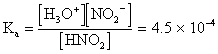
In contrast to strong acids, weak acids do not dissociate completely. The
equilibrium
constant for the dissociation is known as the acid-dissociation constant.
HNO2
+ H2O  H3O+
+ NO2-
At 25°C
Salts of weak acids and weak bases
Although it is assumed that all salts dissociate completely into their ions
when they
dissolve in water, the pH of the solution depends upon the acid and base from
which they
are derived. The anions and cations of weak acids and bases undergo hydrolysis (they
react with H2O) and accept a
proton or
give a proton to the water, i.e.
NO2-
+ H2O
HNO2
+ OH
-
(basic solution)
NH4+
+ H2O
NH3
+
H3O+
(acidic solution)
Thus, the solutions of these species will either be basic of acidic as in the
above examples.
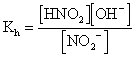
The equilibrium constant for these reactions is known as the hydrolysis
constant, Kh:
Kh
for the NO2-
ion is equal to

Safety
Avoid physical contact with all species in this lab and wear your safety
glasses.
Prelab Assignment (worth 50 % instead of
35 %. Your lab report will also be worth 50 %. The
prelab must be handed-in again with the report)
Calculate the theoretical pH and the percentage ionization (where indicated) of the solutions 2, 3, 5-10 in Table 1
using the pKa and pKb values provided in the table (or from the
textbook if the values are not provided in the table), and place the
values in Table 9.1. You
must hand in all of these calculations with your lab report. Include all necessary
equations, assumptions and verifications.
Procedure
Methods
Measure the pH of the solutions in Table 9.1 using the pH meter
(instructions below) in duplicate and record the values in the table.
Calculate the average and record it in the table as well.
To proceed, first take one pH measurement of each solution at the
different stations available, and then return to obtain your second
measurement. That is, do not take both pH measurements at the same
time, but in rotation with the your classmates.
Use of the pH meter
The pH meter is a delicate and expensive piece of laboratory equipment. Handle it with great care!!!
The pH meter will have been calibrated by
the technician. Please do not change it!
The electrode will already be placed in the solution to be measured. Do not remove it from the solution!!
Follow these steps to obtain the pH measurement of your solution:
-
Ensure the instrument is on STAND-BY.
-
Raise the electrode from the storage solution and rinse the electrode with your
wash bottle. Wipe it gently with a tissue and insert the electrode into the
solution to be measured.
-
Take the reading and return the instrument to STAND-BY.
Report
Complete Table 1.