


Water that contains dissolved minerals in relatively large amounts is said to be hard. Although hard water is, within limits, healthful, there are two common problems associated with it.
First, hard water contains cations such as Ca2+ , which form water-insoluble compounds with soaps. These insoluble compounds reduce the cleaning power of soaps and at the same time deposit a grey precipitate on clothes.
Second, hard water encourages the buildup of deposits in water heaters, pipes, etc. which are expensive to replace.
The major ions responsible for water hardness are Ca2+ , Mg2+ , and HCO3- . Heating removes some of the HCO3- as CO2 (g), shown in the reaction below, but also forms boiler scale when the CO32- forms precipitates with the Ca2+ , Mg2+ and Fe3+ present in the water.
 H2O + CO3-
(aq) + CO2
(g)
Water that contains ions not removed by heating is said to be permanently hard.
The purpose of this experiment is to determine the concentration of permanent hardness in water by titrating with a standard solution of EDTA (ethylene diaminetetracetic acid). This acid is a multidentate ligand and forms stable complexes with a variety of ions.
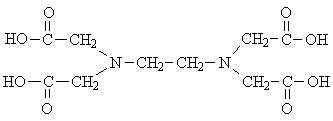
Depending upon the pH, the stability of the complexes is affected. In this experiment the pH will be maintained at 10 using an NH3 / NH4Cl buffer. This will ensure the stability of the complex and will prevent the undesired precipitation of ions such as Cd2+ , Cu2+ , Ni2+ and Zn2+ as hydroxides.
At a pH of 10 the EDTA is mainly in the half-neutralized form H2Y2- . The reaction then is:
Ca2+
+ H2Y2-
CaY2-
+ 2 H+
As all species are colorless, it is necessary to add an indicator, Eriochrome Black T, and a small amount of Mg2+.
When Ca2+ is present in the sample, EDTA forms a complex with the Ca2+ ions. Under these conditions, the indicator (In) complexes with the Mg2+ ion and forms a wine-red Mg-In complex. When EDTA has complexed all Ca2+ ions present in the sample, EDTA then takes a Mg2+ ion from the Mg-In complex forming an EDTA-Mg complex and the acidic form of the indicator, HIn2-. This occurs because the EDTA-Mg complex is more stable than the Mg-In complex. The solution changes color at this point, signaling the end-point of the titration. In other words, the EDTA-Mg complex causes the Mg2+ ion concentration to decrease, and this, in turn, causes the Mg2+-In complex to dissociate. The indicator then reverts to an acid form which is sky blue and thus establishes the end point of the titration.
H2Y2- + MgIn- MgY2-
+ 2 HIn2-
(wine-red color) (sky blue color)
Wear your safety glasses and avoid contact with the chemicals involved. You may want to bring a sample of H2O from home for the second part of this experiment.
Part I: Prepartion of the CaCO3 Standard Solution
Weigh accurately about 0.08 g (0.1 g maximum) of CaCO3 into a 250 mL beaker. Add 25 mL of distilled H2O and then, slowly, add about 20 drops of 12 M HCl. Cover with a watch glass and allow the reaction to proceed until all the carbonate has dissolved. Rinse down the walls of the beaker with distilled H2O and heat the solution until it just begins to boil. Add 50 mL of distilled H2O and quantitatively transfer the solution to a 250 mL volumetric flask. Rinse the beaker several times with distilled H2O and add washings to the volumetric flask. Fill the flask with distilled H2O and mix thoroughly (invert 20 - 50 times).
Part II: Titrations
A. Titration of the blank
Draw about 200 mL of EDTA solution into a dry 250 beaker. Fill the buret with this solution.
Determine a blank by pipetting 75 mL of distilled H2O into a clean 250 mL Erlenmeyer flask. Add 5 mL of pH 10 buffer and two drops of Eriochrome Black T indicator. The solution should turn blue. Add 15 drops of 0.01 M MgCl2 and the solution should turn red. Titrate the solution until the last tinge of purple just disappears. The volume of EDTA added must be subtracted from the total volume of EDTA used in each of the following titrations. Save this solution as a reference for the endpoint in the following titrations.
B. Titration of the CaCO3 Standard Solution
Pipet 25 mL of the Ca2+ solution in the volumetric flask into a clean 250 mL Erlenmeyer flask. Add 5 mL of pH 10 buffer, 2 drops of indicator and 15 drops of 0.01M MgCl2 . Titrate with EDTA until its color matches your reference solution. Repeat for a second and third time.
C. Titration of your water sample
Pipet 50 mL of your water sample (from home or supplied) into a 250 mL Erlenmeyer flask. Add 2 drops of indicator, 5 mL of pH buffer and 15 drops of 0.01M MgCl2 . Carry out as many titrations as necessary to obtain an agreement of 3%.