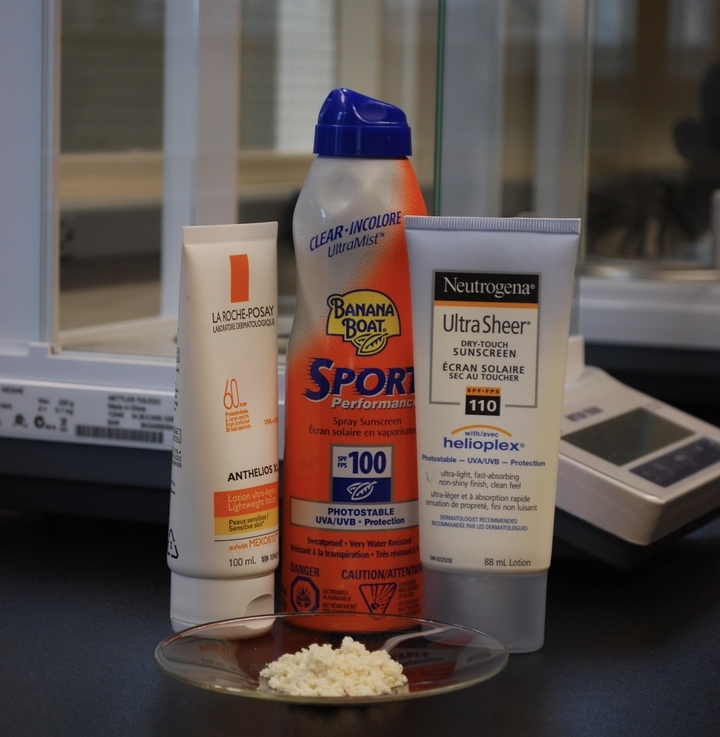
Sunscreens provide an example of the application of three concepts that are important in this course: aromatic systems, conjugated unsaturated systems, as well as ultraviolet (UV) spectroscopy.1
The structure of p‑aminobenzoic acid (PABA) differs from the 20 naturally occurring α‑amino acids in that the amino group of PABA is attached to the δ carbon instead of being attached to the α carbon (see Figure 1 below).2 Nonetheless, PABA is classified as an amino acid, because it has both an amino group and a carboxyl group in the same molecule. As an amino acid, PABA is physiologically active.3 Enzymes incorporate it into folic acid (structure presented in Figure 2 below) along with pteridine and glutamic acid.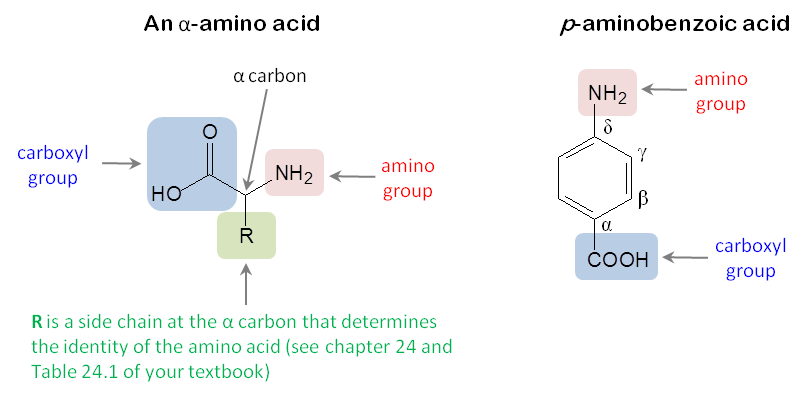 |
| Figure 1. Structures of an α‑amino acid and of p‑aminobenzoic acid (PABA)2,3 |
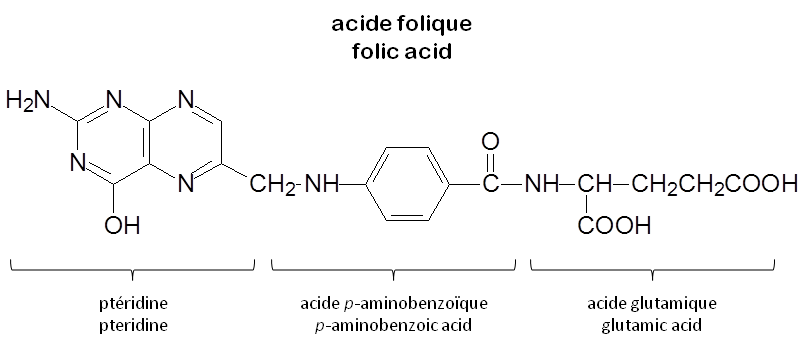 |
| Figure 2. Folic acid molecule showing the pteridine, p-aminobenzoic acid and glutamic acid parts2,3 |
Humans can ingest folic acid from leafy greens and vegetables, but bacteria in the intestine must manufacture folic acid. Some drugs, like sulfanilamide, have structures similar to that of PABA and act as competitive inhibitors.4,5 Thus, when sulfanilamide binds to the reactive site of the bacterial enzyme, the enzyme can no longer catalyze the synthesis of folic acid and this inhibits the proliferation of the bacteria.
In this experiment, you will synthesize p‑aminobenzoic
acid following the reaction sequence below (Figure 3).3 First, the amino group of p-toluidine is first protected by an acetyl group, creating an
acetamido group. This protection step
makes the benzene ring resistant to destruction by oxidation when potassium
permanganate is added during the next step (see your textbook by Solomons and Fryhle
for a detailed description of protecting groups: 12th edition6 – section 15.12A
on page 690). In step two, the methyl
group of p‑methylacetanilide is
oxidized by potassium permanganate to give p‑acetamidobenzoic
acid. In the final step, the acetamido
group is hydrolyzed (i.e. the protecting group is removed) to regenerate the
amino group producing p‑aminobenzoic
acid. Once PABA is
obtained, you will then analyze it using several different
analytical methods. You will also learn how
to create an emulsion by preparing a cream or a sunscreen containing zinc oxide.
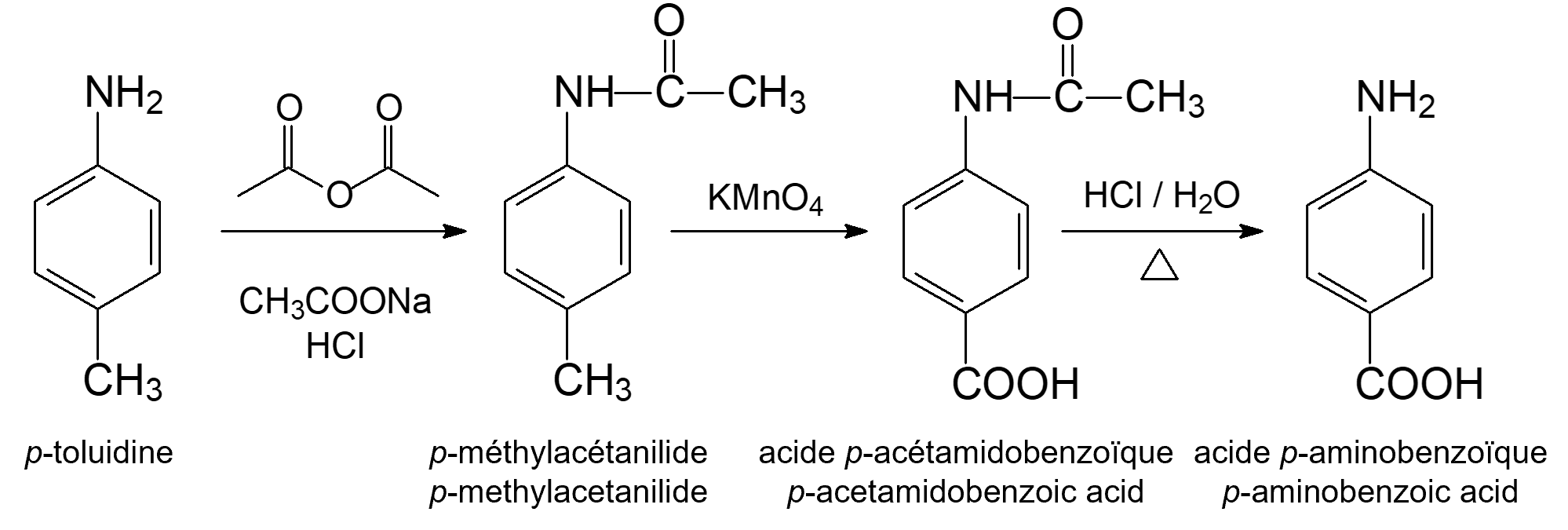 |
| Figure 3. Reaction sequence for the synthesis of p-aminobenzoic acid (PABA) |