Extraction of caffeine from tea(updated 29 Oct 2024) |
Extraction of caffeine from tea
The introduction to the extraction of caffeine is provided in Chapter 7 Extraction of Macroscale and Microscale Experiments 5th edition by Williamson).1 It is required reading! Read the theory pertaining to extractions on pages 135 to 145, as well as the theory pertaining to the extraction of caffeine from tea on pages 162 and 163.
Liquid-liquid extraction
An
organic chemist in the laboratory must separate
and purify mixtures of
compounds. Mixtures of compounds may be
obtained when synthesizing a particular substance by a chemical reaction. When the chemical reaction is complete, it is
necessary to do a workup, that is, to
separate and purify the desired product from the mixture of by-products and
residual starting material. Mixtures may
also result when a natural product is isolated from its source. For example, once eugenol (a dental analgesic
and antiseptic) is isolated from cloves, it is necessary to separate and purify
eugenol so that it may be characterized.
Compounds are separated by their solubility
differences in a aqueous and organic solvent.
An item of glassware called a separatory funnel is used for the extraction. When two insoluble liquids are added to the
separatory funnel, two layers form, with the less dense liquid on top and the
more dense liquid on the bottom.
Suppose a
mixture of cyclohexanol (C6H11OH ) and NaCl is added to a
separatory funnel containing an organic solvent, CH2Cl2,
and H2O. Following the
predictive rule “like dissolves like,”
cyclohexanol would dissolve in the organic CH2Cl2 layer,
and NaCl would dissolve in the water layer.
Separating the organic and aqueous layers, and placing them into
different flasks separates the cyclohexanol and NaCl from each other.
Remember: Water and organic solvents are two different kinds of solvents. Water is very polar (in fact the most polar), and is capable of forming hydrogen bonding intermolecular interactions with a solute. Many organic solvents are either nonpolar, like CCl4 and hexane, or weakly polar like dichloromethane (CH2Cl2) and diethyl ether (CH3CH2OCH2CH3).
Ionic compounds are held together by strong electrostatic forces, so only very polar solvents are able to dissolve them. Most ionic compounds are soluble in water, but are insoluble in organic solvents. To dissolve an ionic compound, the strong ion-ion interactions must be replaced by many weaker ion-dipole intermolecular interactions.
Most organic compounds are soluble in organic solvents (remember like dissolves like). An organic compound is water soluble ONLY if it contains approximately one polar functional group for approximately every 5 C atoms it contains. In other words, a water-soluble organic compound has an O- or N-containing functional group that solubilises its nonpolar 5-carbon backbone.
Scenario 2
How could
we separate a mixture of benzoic acid (C6H5COOH) and
cyclohexanol? Both compounds are
organic, and as a result, both are soluble in an organic solvent such as CH2Cl2
and insoluble in water. If a mixture of
benzoic acid and cyclohexanol were added to a separatory funnel containing CH2Cl2
and water, both would dissolve in the organic CH2Cl2
layer, and the two compounds would not
be separated from each other.
Is it possible
to use liquid-liquid extraction to separate two compounds of this sort that
have similar solubility properties? If a
carboxylic acid is one of the compounds, the answer is YES. Why?
Because we can use acid-base chemistry to change the solubility properties
of the carboxylic acid. This type of
liquid-liquid extraction is, more specifically, called an acid-base
liquid-liquid extraction, and involves carrying out simple acid-base reactions
to separate compounds from each other.
When
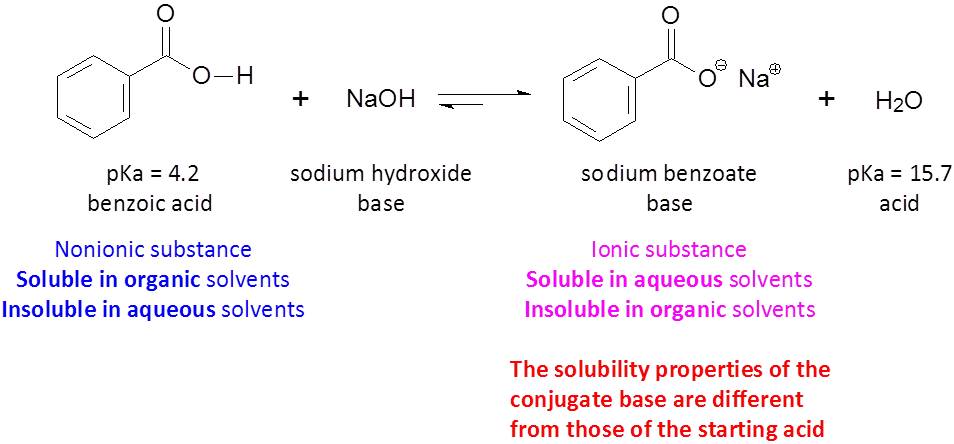
benzoic acid (a stronger organic acid) is treated with aqueous NaOH, benzoic
acid is deprotonated, forming sodium benzoate (see reaction 1 below). Because sodium
benzoate is ionic, it is soluble in water, but insoluble in organic
solvents.
Remember: Acid-base reactions always favor the formation of the weaker acid and weaker base.
| Reaction 1. The reaction of benzoic acid with sodium hydroxide |
|
Thus, a carboxylic acid can be
separated from other organic compounds by converting it into a water-soluble
carboxylate anion by an acid-base reaction.
A similar
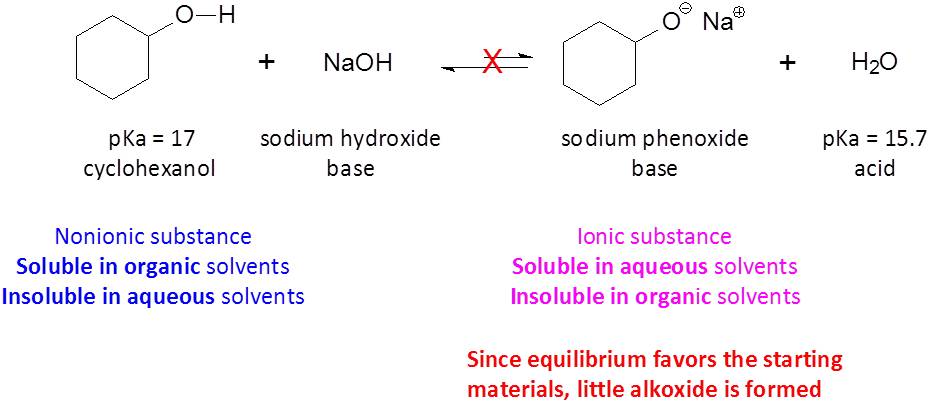
acid-base reaction does not occur when cyclohexanol is treated with NaOH,
because organic alcohols are much weaker organic acids, and, therefore, they
can only be deprotonated by a very strong base such as NaOH (see reaction 2 below). NaOH is not strong enough to form significant
amounts of the sodium alkoxide.
| Reaction 2. The reaction of cyclohexanol with sodium hydroxide |
 |
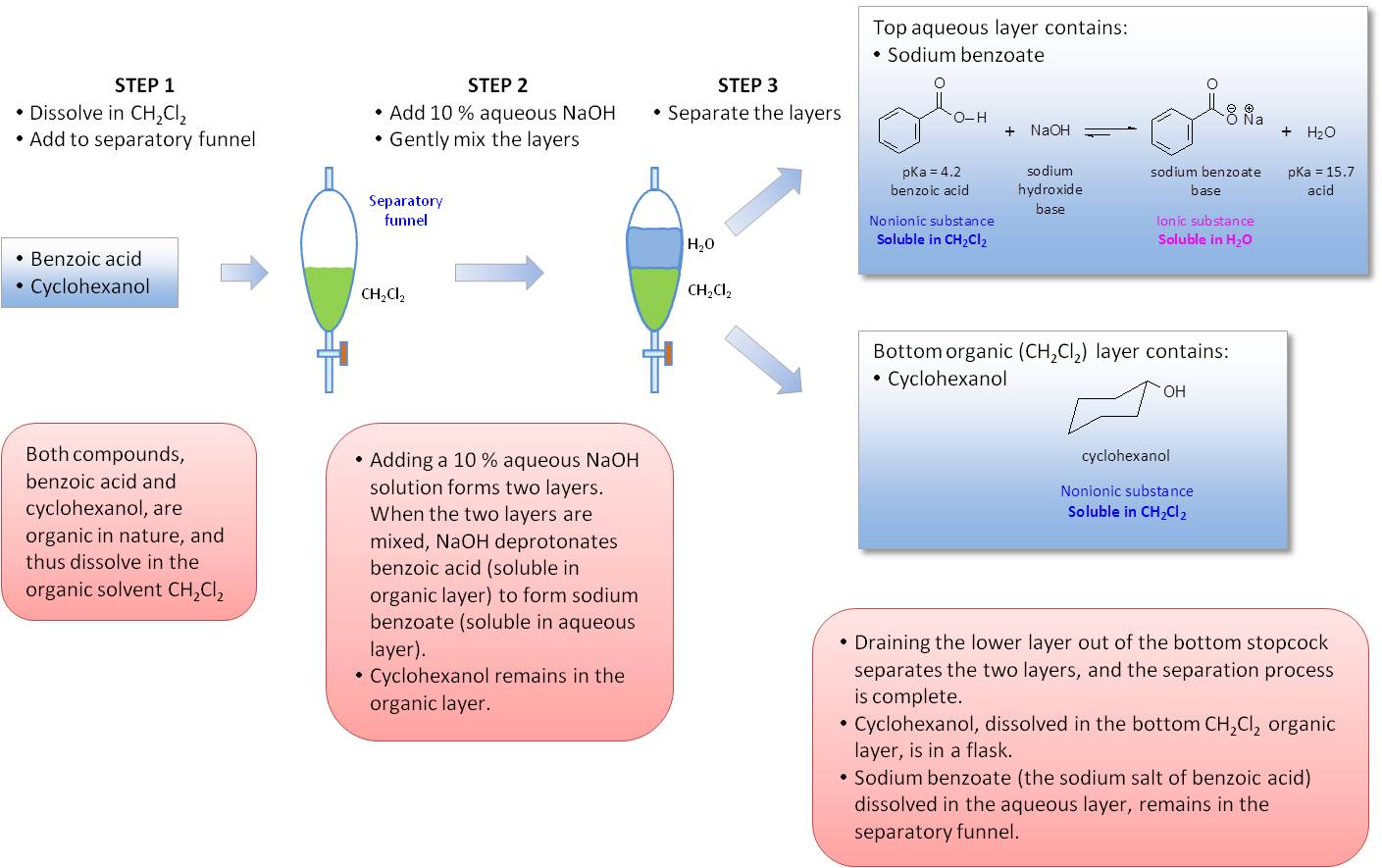
| Diagram 1. Separation of benzoic acid (strong acid) and cyclohexanol (weak acid) by a liquid-liquid extraction procedure with 10% NaOH and dichloromethane (CH2Cl2) |
 |