Acetylsalicylic acid Project(updated 18 Aug 2025) |
Acetylsalicylic is a medication known more commonly as aspirin.1 In the human body, it acts as an analgesic, anti-inflammatory and anti-pyretic. It is also known to have some anti-coagulant properties. In 1860, the German chemist, Hermanne Kolbe, synthesized salicylic acid from phenol (hydroxybenzene), but the acidity of this substance irritated the digestive system. It was only in 1893 that Felix Hoffmann, a young chemist working for the Bayer company, discovered a related substance, acetylsalicylic acid, which seemed to be less of a digestive system irritant, and was, therefore, better supported by the human body.
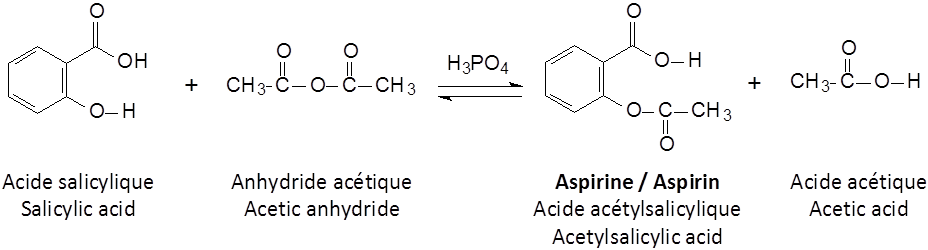
In this experiment, aspirin will be synthesized and analyzed.1,2 The ester (aspirin) is obtained by an acid-catalyzed reaction between the hydroxyl group of salicylic acid and acetic anhydride (see the chemical reaction just below). The reaction is catalyzed by hydronium ions from phosphoric acid. To begin crude aspirin will be synthesized, and then purified by recrystallization. Several analytical methods will be used to determine whether aspirin was indeed synthesized and to assess its purity, namely the determination of its melting point and the ferric chloride qualitative chemical analysis.